
| Dec 8, 2024
Manufacturing Generative Engine Optimization (GEO) for Industrial Companies – An Agency’s Playbook
Generative Engine Optimization (GEO) is a optimization framework for improving web content visibility in AI-powered search engines, also known as generative engines (GEs). Examples of generative engines include: ChatGPT, Perplexity AI, Google AI Search, Gemini, and Copilot.
GEO builds upon Search Engine Optimization (SEO) best practices which are a set of well-known techniques industrial marketers use to improve their natural or organic website rankings on Google, Bing and other international search engines.
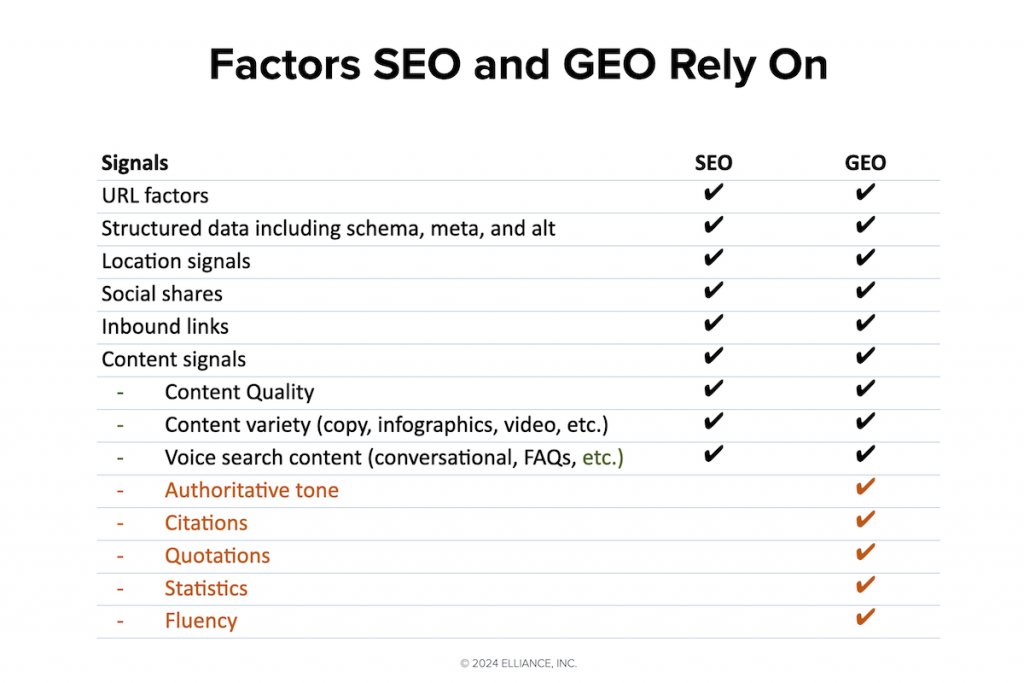
I discuss SEO factors in other blog posts, but here I’ll review additional factors that increase the probability of your products and content surfacing in answers offered by generative engines.
Buyers Aren’t Just Searching for Suppliers. They’re Asking Questions.
Traditional SEO assumes buyers search for products and services by their name. AI search tools flip that assumption.
Prospective buyers now ask questions.
Implication:
In addition to securing Google rankings, your content strategy must be structured around questions, comparisons, and explanations, not just keywords and product names.
This means:
- creating frequently asked questions on the product pages,
- creating explainer content AI tools can summarize accurately,
- clearly articulating product applications, distinctions and case studies,
- and designing pages that answer “why the product was created” before “how to use the product.”
If AI can’t understand your product, it can’t recommend it.
Speak with an Authoritative Tone
To reflect knowledgeability and trustworthiness in their responses, the generative models are naturally attracted to content that is authoritative sounding and contains technical terms. Therefore, modifying the tone of content to be more persuasive and authoritative will boost the probability of your content surfacing on generative search. This is especially true for debate style questions and queries in business, science and health information.
Share Citations Generously
Because generative models have been criticized for generating plausible-sounding but incorrect answers, they are placing extra emphasis on citations. Therefore, addition of citations to credible sources in your content increases the chances of it appearing in generative search results. This is especially true in response to factual questions.
Share Quotations From Subject Matter Experts
Adding direct quotes to the digital content can add authenticity and depth to the content. Generative engines are especially biased towards quotations.
Cite Statistics
Augmenting qualitative discussions with relevant statistics wherever possible ensures increased source visibility in the generative engine response.
Speak with Fluency and Write Comprehensibility
Generative engines have an easier time processing and ranking clear, concise and easy-to-understand writing. Keeping this in mind, writing copy that informs, persuades, engages and delights readers will ensure your pages will surface in generative responses. Avoid keyword stuffing because it has a negative impact on both search engine and generative engine rankings. Fluency and democratized communications are especially rewarded with higher rankings for business, science and health related content.
A Note About Content Quality, Social Shares and Inbound Links
There is a strong connection between the quality of content and its performance in terms of shares and backlinks; engaging, credible content typically attracts both. Fostering guest blogging, creating shareable infographics and publishing original research will not only attract organic inbound links but also ensure your content will be included in generative results. Using a robust internal linking structure also helps AI understand content relationships on your site.
Back in November 2023, Aggarwal, Murahari, Rajpurohit, Kalyan, Narasimhan, and Deshpande from Princeton, Georgia Tech, The Allen Institute of AI, and IIT Delhi and published a paper titled “GEO: Generative Engine Optimization”. This blog post is partly inspired by their findings and partly by Elliance experience and observations.
Aggarwal et al.’s research indicates that GEO can significantly improve visibility for smaller websites that typically rank lower in search engine results pages (SERPs). However, we have not found this to be the case. Our experience shows that the higher a website is on SERPs, the better chances it has of being included in the AI Search snippets.
Generative search is finally ushering in the era of evidence-based marketing, something we’ve been practicing for the past 30 years.
If you are seeking a manufacturing marketing agency partner with proven experience in industrial GEO marketing in aerospace and defense, automotive, chemicals, construction and engineering, electronics, energy, food and beverage, furniture, industrials, metals and mining, oil and gas, retail and consumer good, tooling, textile and apparel, transportation equipment, and wood and paper products companies, we would welcome a conversation.