
| Aug 9, 2026
SEO, GEO and AIO: The Evolution of Search to Answer Optimization in Higher Ed
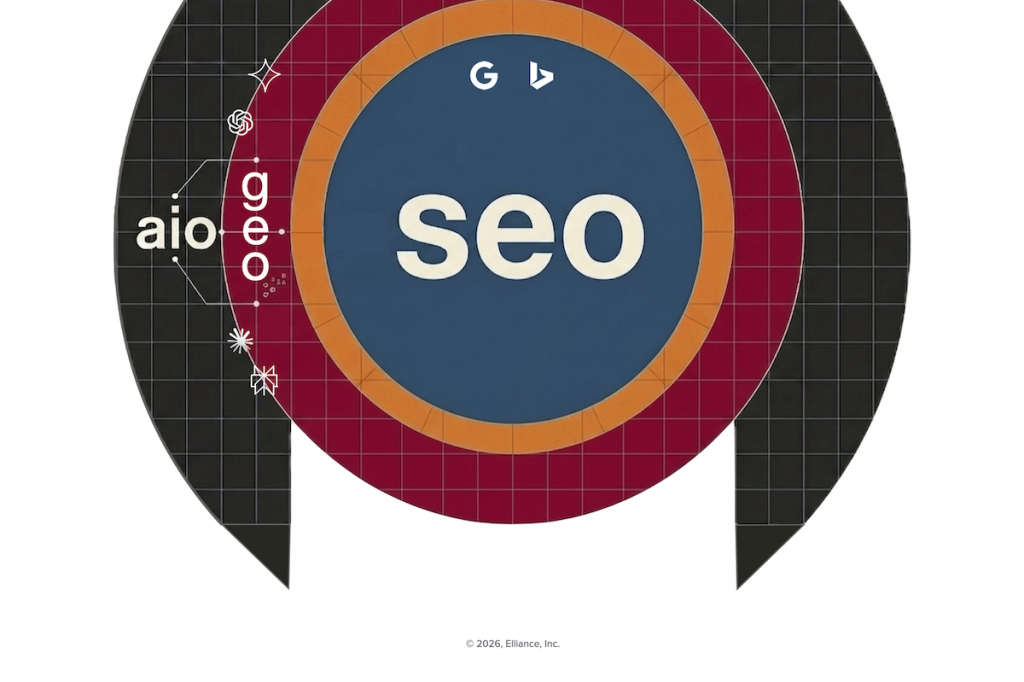
Ever since tools like ChatGPT, Perplexity, Claude, and Google AI Overviews came onto the scene, the search landscape has fundamentally changed. Today’s prospective students and parents aren’t just clicking through traditional “blue link” search results anymore; they’re asking questions and getting instant, synthesized answers right on the page.
The scale of this shift is hard to ignore: while Google still dominates with 8.5 to 14+ billion daily searches, ChatGPT now processes roughly 2.5 billion daily queries, with Gemini closing in at around 1 billion. On top of that, Google now triggers AI Overviews on nearly half of all search queries. For higher ed marketers, this means SEO is no longer just about ranking on a page; it’s also about becoming the answer AI chooses to share.
First, a quick translation of the jargon. SEO helps your site earn visibility in traditional search results on Google and Bing. GEO helps your content be discovered, cited, or summarized in AI-generated search experiences such as Google AI Overviews, Perplexity, ChatGPT, and Gemini. AIO, as we use the term, is the broader discipline of making your brand, content, and technical foundation understandable, trustworthy, and consistently usable across AI-driven search and assistant experiences, including ChatGPT and Claude.
What’s Evolving
SEO is evolving, but this whole space is also full of misinformation. Here are a few myths and realities about this shift:
Myth #1: SEO is dead. AI has replaced it. We should shift 100% of our strategy to AI search.
The Reality: Traditional SEO is still the foundational engine for AI visibility. In fact, our analysis shows that SEO and GEO share 9 of 14 factors that determine visibility. AI answer and generative search experiences source their information directly from well-optimized web infrastructure. You don’t abandon SEO; you evolve it so you’re ranking in classic search results and being cited by AI models simultaneously.
Myth #2: AI models only read what is written on your official .edu website.
The Reality: Beyond the institutional website, AI engines increasingly draw on signals from across the web. They scan Reddit discussions, news articles, college review sites, and social platforms to figure out what people actually say about your university. Like Google, AI engines increasingly look beyond your website, considering what third parties say about you across the web alongside what you say on your official website.
Myth #3: To win over AI search, we need massive, deep-dive articles.
The Reality: AI engines favor an inverted pyramid writing approach, which puts the most important information first, followed by key details and background information at the end. Since they need clear information they can confidently summarize and cite, they prefer crisp, structured, and direct copy over wordy essays.
Myth #4: If our university ranks #1 on Google, ChatGPT, and Gemini will automatically cite us.
The Reality: Ranking first on Google gives you a head start, but it’s not a guarantee for AI answer inclusion. AI tools use different evaluation criteria (clarity, consensus, authority, citations, and corroborating evidence), which is why top-ranking Google pages are frequently left out of AI-generated responses.
Myth #5: Just adding FAQs and Schema markup will make a page rank in AI answers.
The Reality: FAQs are great user helpers, but they are not a silver bullet for inclusion in AI-generated answers. Schema markup also helps machines understand your site, but if the underlying content lacks depth, clarity, and authority, AI models will simply skip over it. FAQs and schema are important, but neither is a substitute for strong content.
Myth #6: A university needs to create boatloads of AI-generated blog posts to win in AIO/GEO visibility.
The Reality: It is true that fresh and useful content remains important for SEO/AIO/GEO visibility; however, flooding the website with generic AI content doesn’t really help a college. What search systems value is original research, real student stories, unique program outcomes, genuine career advice, and thought leadership ideas. Quality and authenticity beat AI-generated content every single day.
Myth #7: Zero-click searches mean our higher ed marketing strategy is failing.
The Reality: A zero-click search occurs when a student gets the answer to their query directly on the search engine results page — via AI overviews, featured snippets, or knowledge panels — without needing to click through to an external website. Zero-click search feels alarming at first, but paradoxically it’s also a quality filter. Traffic volume might drop because casual skimmers get instant answers in AI overviews, but the students who do click through to your site are likely to be far more serious, informed, and ready to apply.
Myth #8: Search optimization and answer optimization are the same thing.
The Reality: Search optimization asks: How do I get ranked? Answer optimization asks: How do I become part of the answer?
What Endures
#1: Students still want answers to all their questions from one academic program page, not hunt through 10 pages on a college website.
Academic program pages are money pages where prospective students and families make their decisions. Most university websites are losing the AI battle because the answers to commonly asked questions about an academic program are scattered across dozens of pages, buried in institution-first language. What actually works is a single, high-fidelity academic program page that addresses their core questions in one place: Can I afford this? Will I get in? Who’ll teach me? What opportunities will I have? What’s campus life like? Will this degree get me a job? Will I be happy here? Give them clear answers in one place, and you make the page more useful for the student and the search system.
#2: Students still want useful, persuasive, and delightful information, irrespective of rankings.
Ranking gets your college noticed, but informing, persuading and delighting prospective students gets them to enroll. Great content solves a prospective student’s problem first; being selected as the top search answer is just a fortunate byproduct of doing that well.
#3: AI can recognize the principles of persuasion, but can’t experience it.
AI can recognize Robert Cialdini’s six principles of persuasion, but it doesn’t experience persuasion the way humans do. It can identify Authority, Social Proof, and Commitment and Consistency in data, reviews and content, and it can surface signals of Liking, Reciprocity and Scarcity. But recognizing a persuasion signal isn’t the same as being persuaded by it. The future of AIO and GEO is about creating content that is persuasive to humans and understandable for machines.
#4: Human stories and emotional resonance are more important than ever.
AI makes human stories more important, not less. Two marketing truths still apply: facts tell, stories sell; we buy on emotion and justify with logic. Prospects are not rational automatons who only make decisions based on facts; they are drawn to brands that touch their hearts (with stories of triumph despite the odds, achievement, belonging, inspiration, empowerment, pride, future readiness, rigorous training, etc. all in service of health, wealth and love) and reflect the values they hold dear. Marketing imagination still wins. This enduring wisdom has not changed since local rags were joined by billboards, radio, tv, internet, search engines, social media and now AI. In the AI era of a factual arms race, stories will create the future winners and losers; and brands will still become the stories they choose to tell. AI will certainly make information more abundant. Human stories will continue to make choices more meaningful.
In the world of AI, the goal is no longer simply to rank a university web page on Google page one. It is also to ensure the institution can be found, understood, accurately represented, and trusted whenever prospective students, parents, partners and funders ask their questions. The future of higher-ed SEO is about a college being found on search engines and becoming the answer or part of the answer in answer engines. Yet, colleges with the strongest meaning, deepest trust, most persuasive stories and most compelling experiences will be the winners.
Can’t outspend well-funded competitors? Out-answer them. Ask us for an SEO/GEO/AIO audit to identify the content, technical and authority gaps that may be keeping your university from being found, understood and cited.