
| May 31, 2025
The Art and Science of Higher Education SEO, GEO and AIO: An Agency’s Playbook

The art and science of higher education SEO, GEO and AIO marketing begins with understanding what prospective students, faculty, staff, partners and funders truly seek—not just keywords, but clarity, purpose, and an ambitious path forward. The science is precision: using data to anticipate intent, select the right keywords, structure content, and harmoniously marry code and content. The art aligns content with how real students search—combining long-tail and high-traffic keywords, adapting to dialects and intent, and guiding prospects from curiosity to conversion with data-driven precision, answering their questions that are now being posed as natural language.
Definitions First
First, a quick translation of the jargon. SEO helps your site earn visibility in traditional search results on Google and Bing. GEO helps your content be discovered, cited, or summarized in AI-generated search experiences such as Google AI Overviews, Perplexity, ChatGPT, and Gemini. AIO, as we use the term, is the broader discipline of making your brand, content, and technical foundation understandable, trustworthy, and consistently usable across AI-driven search and assistant experiences.
Search optimization asks: How do I get ranked? Answer optimization asks: How do I become part of the answer?
The Science of Higher Education SEO, GEO and AIO
The science of higher education SEO, GEO, and AIO marketing is the disciplined application of analytical insight to strategic positioning. It transforms guesswork into precision by marrying data, technology, and user behavior to shape institutional visibility. At its core, it’s about making better choices: what to optimize, whom to target, where to compete and what to do next—all informed by data, measurement and experience.
Strategic Prioritization of Programs
Use search demand and conversion data to prioritize which academic offerings deserve focus—making marketing a reflection of institutional ambition and marketplace need.
Empirical User Understanding
SEO/GEO/AIO science brings structure to how prospective audiences behave in digital spaces—tracking keywords, pathways, and pain points to inform design and content.
Keyword Research & Intent Mapping
Start with searcher intent. Behind every query is a hope, a problem, a future. Build content that answers with elegance. Identify what prospective students, parents, faculty, staff, partners, funders and influencers are searching for — and why. Tools such as Google Keyword Planner, SEMrush, or Ahrefs help uncover high-value keywords tied to programs and outcomes.
Technical SEO/GEO/AIO Implementation
SEO/GEO/AIO isn’t one thing—it’s everything. Site speed, responsive design, architecture, metadata, voice search. Optimize site speed, mobile responsiveness, crawlability, indexability, site architecture, and schema markup — the technical foundation of a healthy site.
On-Page Optimization
Ensure headings, metadata, internal linking, and keyword placement are aligned to user intent and optimized for both humans and search engines.
Conversion Rate Optimization (CRO)
Test and refine CTAs, forms, page layouts, and messaging to improve inquiry submissions, application starts, and yield.
Link Building & Domain Authority Growth
Earn highest quality backlinks from trusted sources (e.g., media, .edu domains, .gov domains, influencers) to improve credibility and rankings.
Local SEO/GEO/AIO Targeting
Optimize for location-specific searches using Google Business Profiles, local keywords, and geographic segmentation—especially useful for regional programs and campuses.
Compliance and Accessibility
Ensure SEO/GEO/AIO efforts align with ADA requirements and accessibility best practices for inclusive user experiences.
User Behavior Tracking
Track click paths, heatmaps, session recordings, and goal completions to understand user flow and identify friction points.
Content Performance Analysis
Use analytics tools (e.g., Google Analytics, Looker Studio, Matomo) to assess content engagement, bounce rates, and conversions, adjusting strategy accordingly.
Search Engine and AI Discoverability Optimization
Understand and adapt to Google’s ranking factors (e.g., Core Web Vitals, mobile-first indexing, GEO/AI search) to improve SERP positions.
The following infographic encapsulates some of these factors: SEO, GEO and AIO Ranking Factors.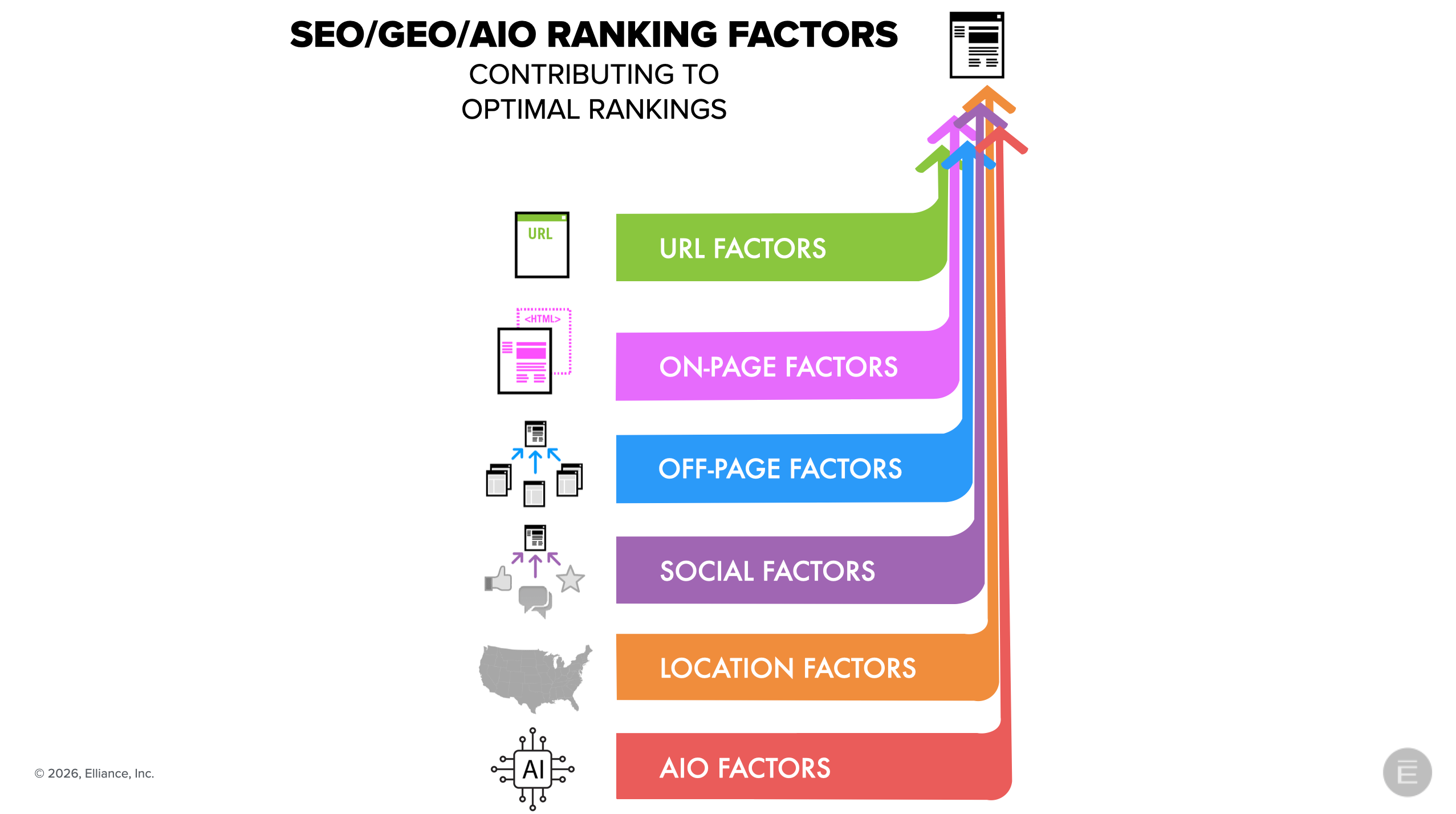
The Art of Higher Education SEO, GEO and AIO
The art of higher education SEO, GEO and AIO marketing lies in empathetically understanding how prospective audiences translate their ambitions into searches. It’s about translating that insight into elegant, resonant content that aligns institutional offerings with real human intent. At its best, it balances intuition and data to focus on the right keywords. Four examples:
Optimize for GEO (Generative Engine Optimization) and AIO (AI Discovery Engine Optimization)
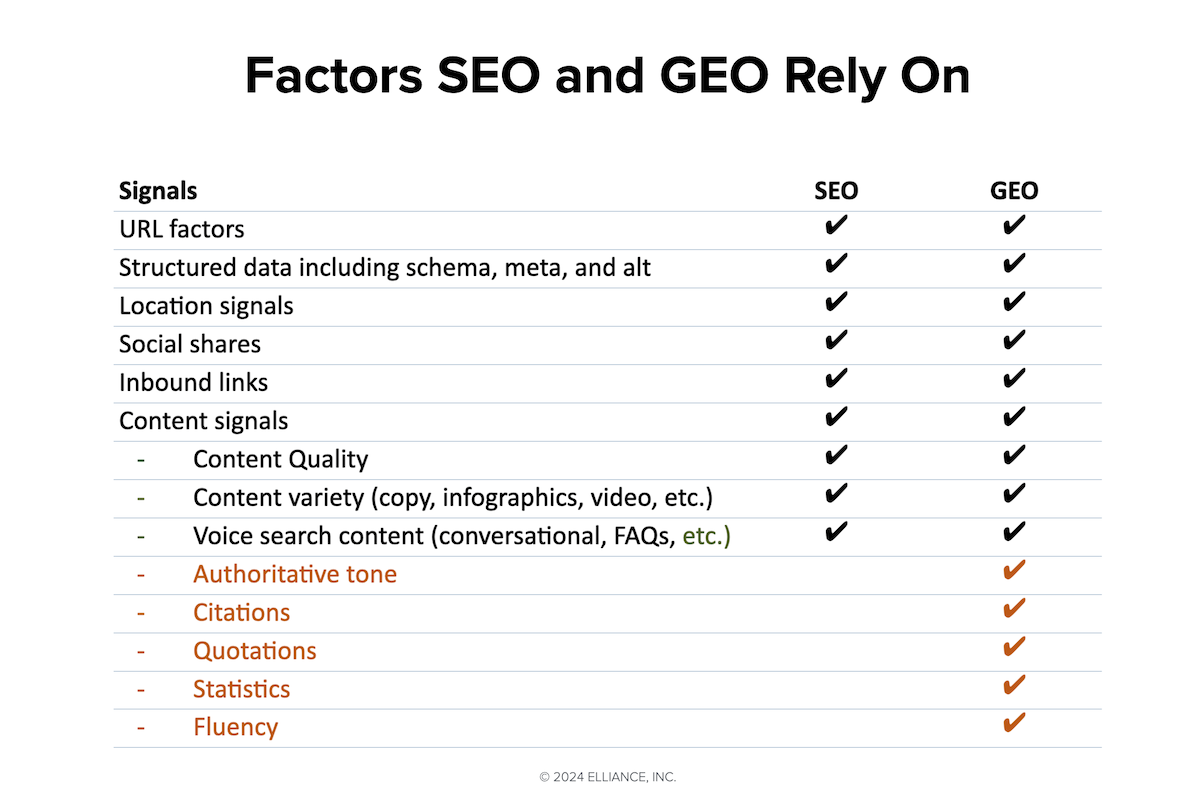
GEO/AIO optimization builds upon Search Engine Optimization (SEO) best practices. Research from Princeton, Georgia Tech, the Allen Institute and IIT Delhi, published in “GEO: Generative Engine Optimization,” found that factors including authoritative tone, citations, quotations by thought leaders, statistics, fluency and content comprehensibility can influence generative-engine visibility.
From Long-Tail SEO to GEO/AIO Answer Optimization
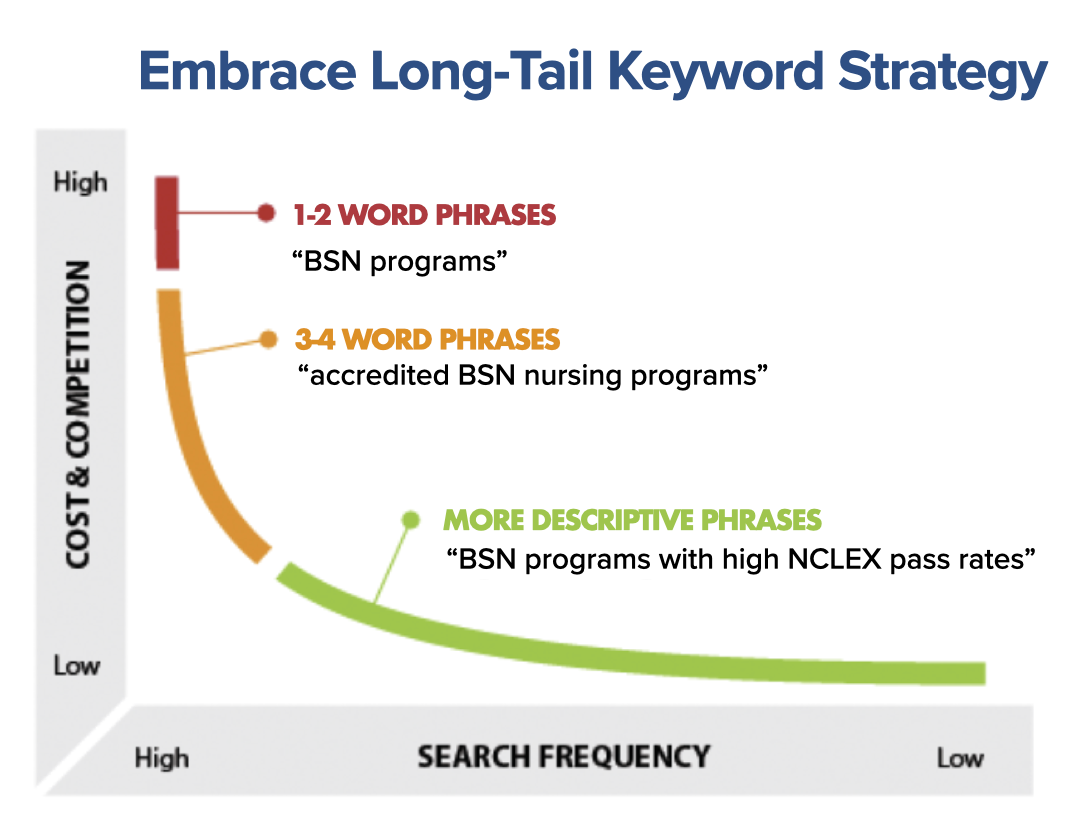
Search optimization asks: How do I get ranked? Answer optimization asks: How do I become part of the answer? Traditional search has long focused on a combination of high-traffic phrases and highly specific long-tail keywords. SEO/GEO/AIO expands that thinking: marketers now need to understand and answer the actual questions people ask, not just the phrases they type. One of the most effective ways to compete for broad, high-value topics is to build authority by answering the many specific questions surrounding them.
With conversational search and AI assistants (ChatGPT, Perplexity, Gemini and Claude), we have entered a new era of natural language, sentence-based, and question-based search. Now marketers must:
- Add frequently asked questions (FAQs): Since people increasingly use conversational, question-and-answer format with AI assistants and conversational search, FAQs can improve discoverability by directly addressing relevant questions.
- Write colloquially. Since people won’t change their speaking habits for the computer, write new content using everyday vernacular.
- Write page summaries. Write short, persuasive, concise page summaries above the screen fold on long-form pages. These summaries give both people and AI systems a concise explanation of what the page is about and can make important information easier to extract and understand.
- Get responsive. Speed it up. If your college website isn’t responsive yet (i.e. auto-adjusts gracefully to mobile devices, tablets and desktops), make it responsive, ensuring it’s fast, fully SEO/GEO/AIO optimized and running in secure mode.
- Build distribution and authority. Promote useful content through social channels, institutional partners, subject-matter experts and relevant communities to expand its reach and credibility.
- Think globally. Act locally. Make your institution’s locations, communities, campuses, service areas and geographic footprint explicit.
- Build strong search visibility. Content that performs well in traditional search can also benefit from the authority, relevance and clarity that contribute to AI discoverability. Measure AI visibility independently.
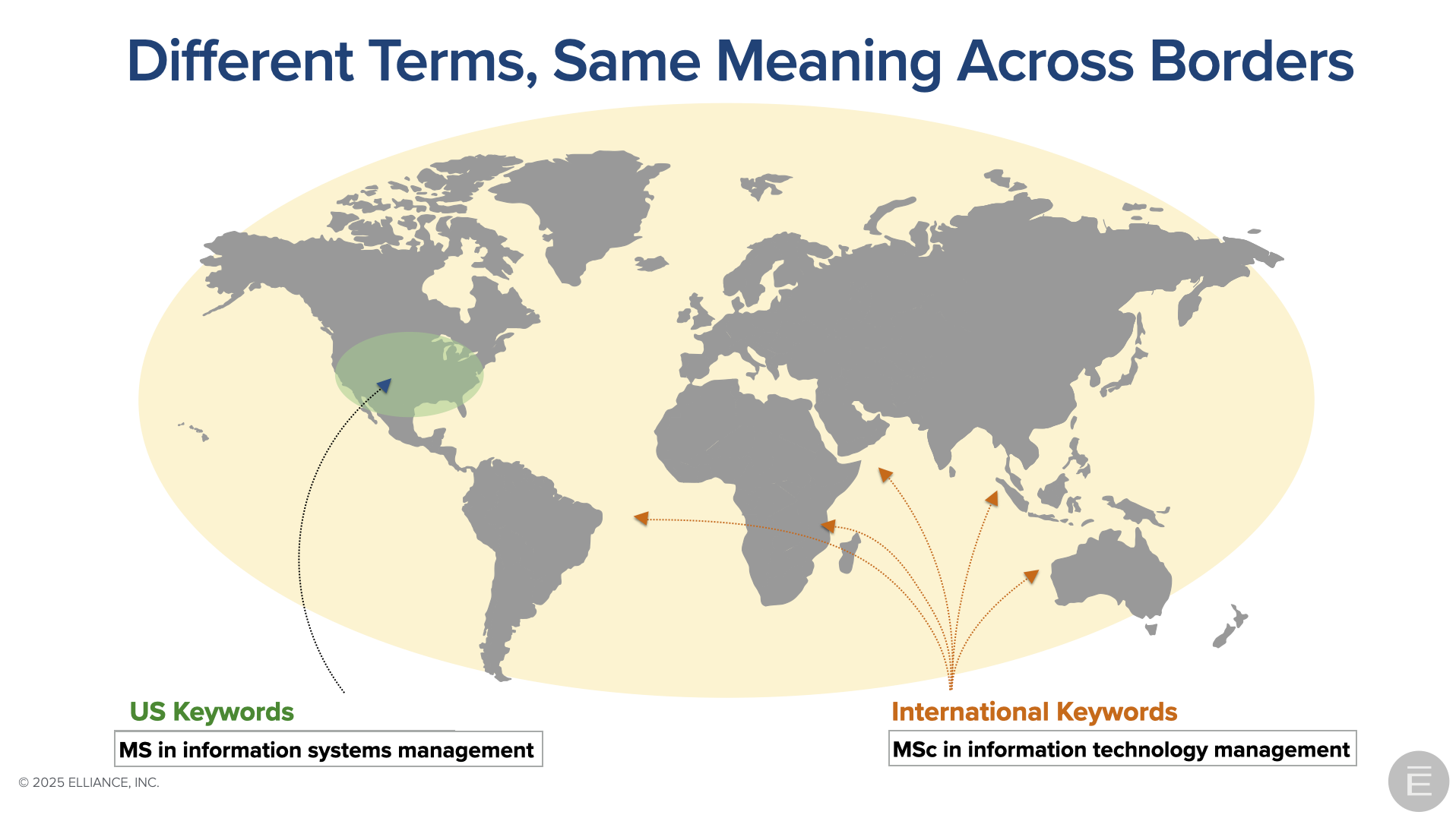
Different Terms, Same Meaning Across Borders
Great SEO/GEO/AIO isn’t about choosing between regional dialects or academic labels — it’s about embracing both. By mapping different terms to the same intent, we bridge cognitive gaps and design a system that meets people where they are, not where we wish they were. As an example, US students tend to look for “MS in information systems management” while international students might look for “MS in information technology management”.
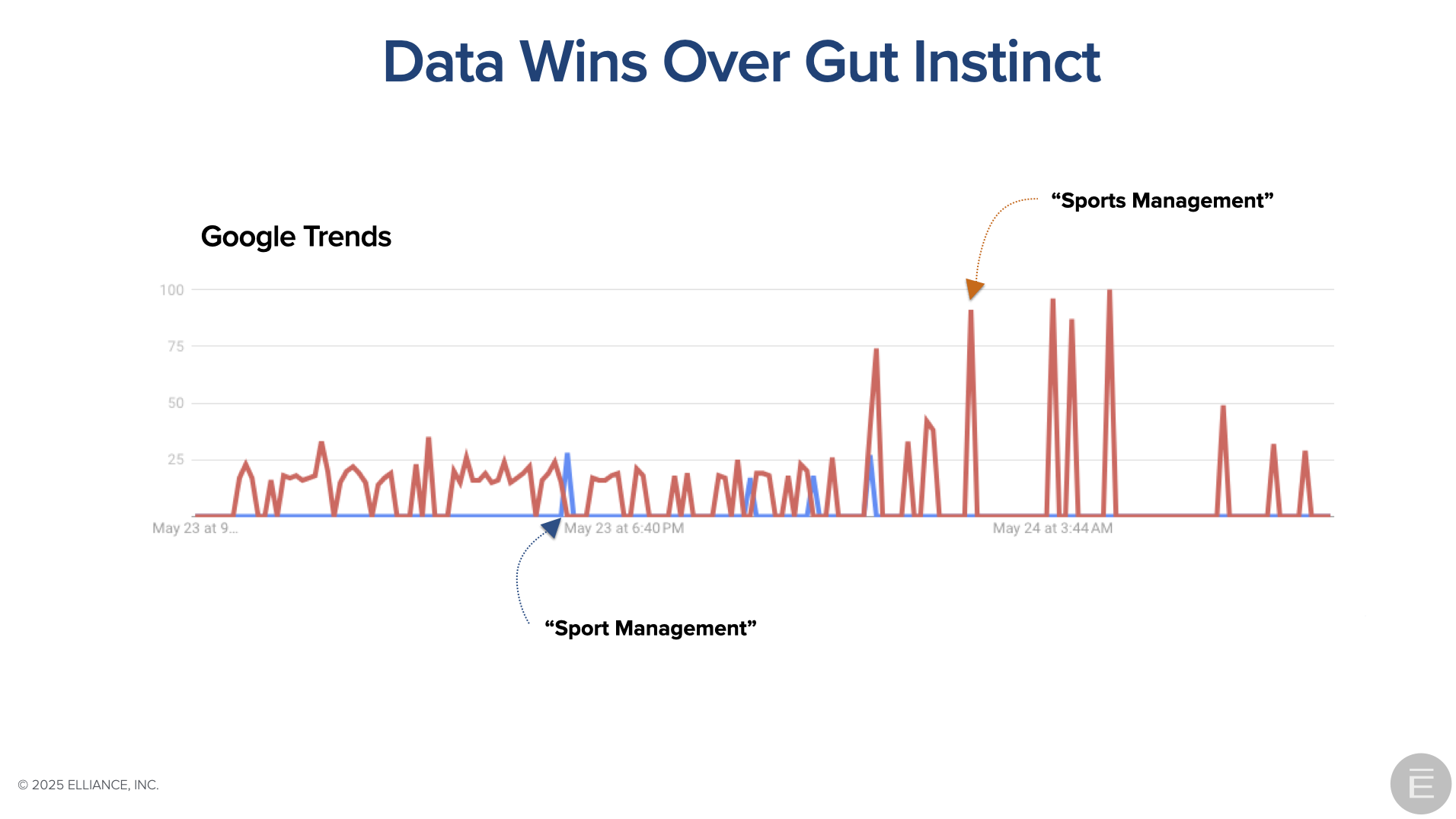
Data Wins Over Gut Instinct
Keyword trends reflect how real people think and search — not how we wish. Rather than rely on gut instinct, we use data to reveal patterns, then design content meeting users where they are. It’s not guesswork; it’s a thoughtful response to the market’s actual language. While a professor’s book may be titled “Sport Management,” ranking the program requires embracing market thinking—optimizing plural “Sports Management” to align with higher search demand and real-world language patterns.
The Right Words at the Right Moment.
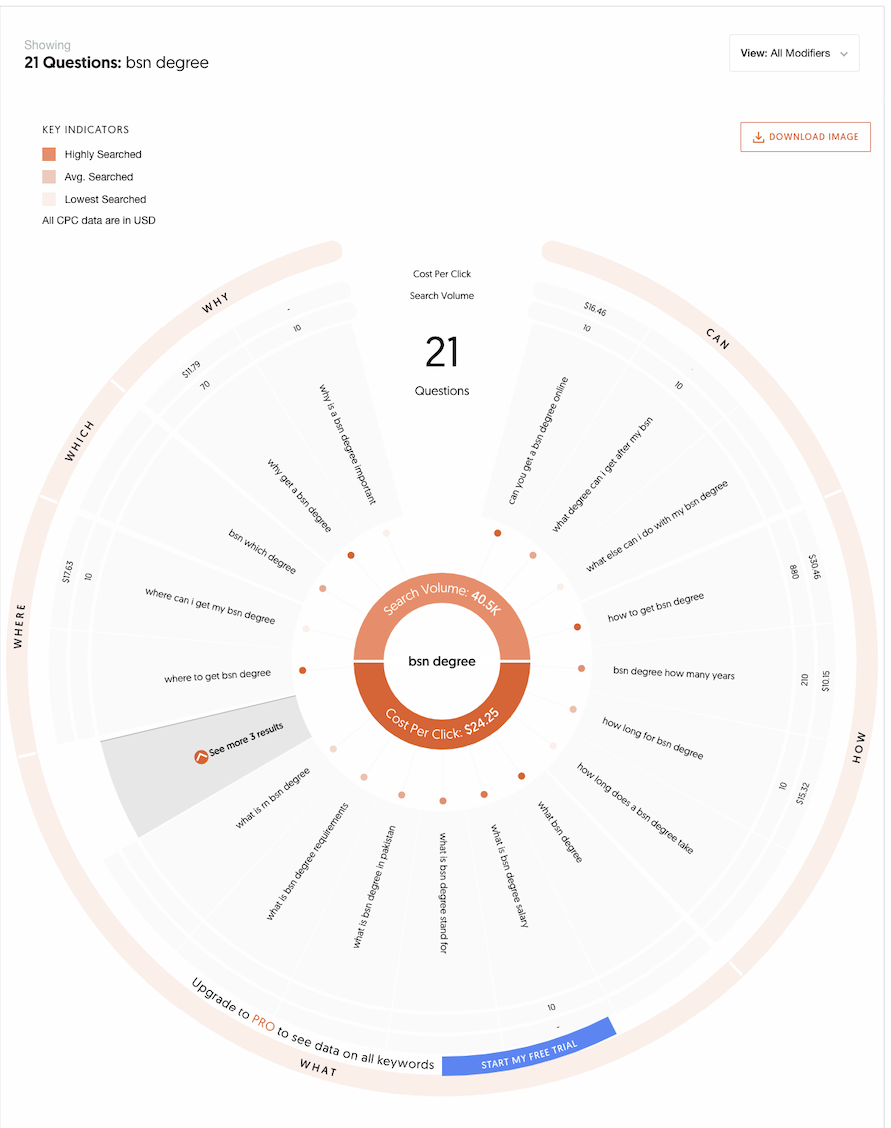
Great marketing meets people where they are. At every stage of the admissions journey — from curiosity to commitment — students ask different questions. Mastering SEO/GEO/AIO means anticipating those questions with precision and answering them gracefully. As an example, there are a lot of nursing programs out there. How does someone with that calling cut through the noise to find the program that’s right for them? It starts with understanding their journey. We’ve mapped it out. Here are the keywords that define each step to your undergraduate nursing program. For your program to surface on Google, ChatGPT, Perplexity and Gemini, create content around questions students actually ask and optimize it using the techniques listed earlier.

Our expertise in securing page-one rankings and visibility in generative engines and AI Overviews spans the full breadth of the higher education landscape — from faith-based and liberal arts colleges to specialized professional schools in law, medicine, STEM and engineering, as well as mission-driven agricultural and technological universities.
If you are too busy to defeat the SEO/GEO/AIO Goliaths in your space, explore our higher education marketing capabilities and consider partnering with us.