
| Nov 11, 2024
Higher Education Generative Engine Optimization (GEO) for Colleges and Universities: An Agency’s Playbook

Back in November 2023, Aggarwal, Murahari, Rajpurohit, Kalyan, Narasimhan, and Deshpande from Princeton, Georgia Tech, The Allen Institute of AI, and IIT Delhi and published a paper titled “GEO: Generative Engine Optimization”. This blog post is partly inspired by their findings and partly by Elliance experience and observations.
Generative Engine Optimization (GEO) is a optimization framework for improving web content visibility in AI-powered search engines, also known as generative engines (GEs). Examples of generative engines include: ChatGPT, Perplexity AI, Google AI Search, Gemini, and Copilot.
GEO builds upon Search Engine Optimization (SEO) best practices which are a set of well-known techniques higher ed marketers use to improve the institution’s natural or organic website rankings on Google, Bing and other international search engines.
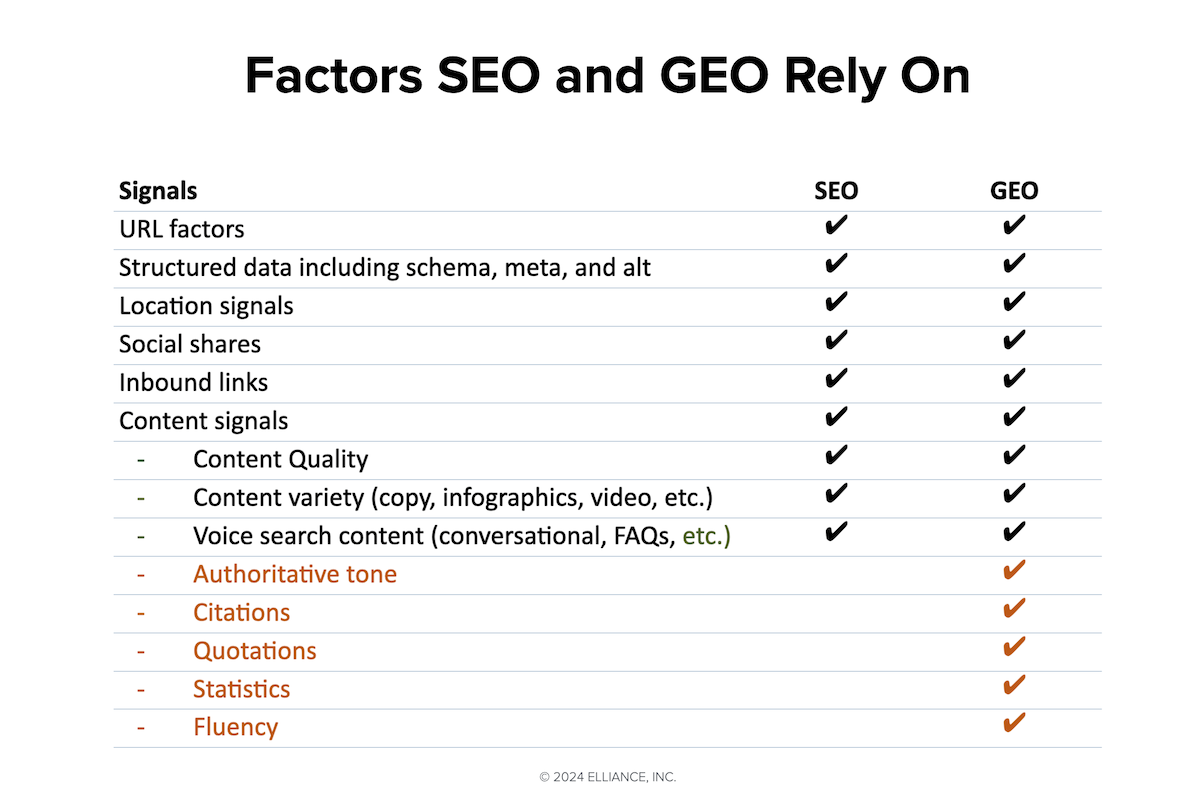
I discuss SEO factors in other blog posts, but here I’ll review additional factors outlined in the GEO study that increase the probability of your content surfacing in answers offered by generative engines.
Authoritative Tone
To reflect knowledgeability and trustworthiness in their responses, the generative models are naturally attracted to content that is authoritative sounding and contains technical terms. Therefore, modifying the tone of content to be more persuasive and authoritative will boost the probability of your content surfacing on generative search. This is especially true for debate style questions and queries in business, science and health information.
Guided by this insight, Elliance used quiet confidence to introduce the newly launched nursing program at John Carroll University:
Bachelor of Science in Nursing (BSN)
Recommitting to the art of nursing in the age of evidence-based and data-driven care. Become a Nurse and Join a Legacy of Innovation.
John Carroll University’s BSN Nursing program builds on Cleveland’s rich history of health innovation, and answers the Jesuit call to magis — doing more for the greater good.
Citations
Because generative models have been criticized for generating plausible-sounding but incorrect answers, they are placing extra emphasis on citations. Therefore, addition of citations to credible sources in your content increases the chances of it appearing in generative search results. This is especially true in response to factual questions.
Let’s say that you are writing a higher education marketing blog to answer the question: what are the top questions prospective students have about a college website. Adding a citation from Nielsen Norman Group would increase the chances of the your blog post appearing in generative answers:
According to Nielsen Norman Group [1], the top questions that prospective students have about a college website are:
– Does the school have the program I’m interested in?
– Can I afford to attend the school?
– What are my chances of being admitted (given my grades and standardized-test scores)?
– What are the campus community and culture like, and will I fit in?
Quotations
Adding direct quotes to the digital content can add authenticity and depth to the content. Generative engines are especially biased towards quotations.
Keeping this in mind, Elliance has introduced student and alumni testimonials for Capitol Technology University in their “Why Capitol Technology” and “Meet our Alumni” pages.
Statistics
Augmenting qualitative discussions with relevant statistics wherever possible ensures increased source visibility in the generative engine response.
With this insight in mind, on Kansas City University’s College of Osteopathic Medicine website homepage, Elliance intentionally introduced six statistics to answer commonly asked questions from prospective students:
– #1 Leading producer of physicians for the State of Missouri
– 99+% Average residency placement rate over the past three years
– 10,000+ Physician alumni worldwide
– 9th Most Impactful Medical School in Primary Care
– 5th Largest private medical school in the nation
– 30% Of KCU alumni practice in underserved areas
As a result, KCU now appears in chatGPT, Perplexity and other generative engines if a prospect searches for “Top Osteopathic Schools in the midwest”.
Fluency and Comprehensibility
Generative engines have an easier time processing and ranking clear, concise and easy-to-understand writing. Keeping this in mind, writing copy that informs, persuades, engages and delights readers will ensure your pages will surface in generative responses. Avoid keyword stuffing because it has a negative impact on both search engine and generative engine rankings. Fluency and democratized communications are especially rewarded with higher rankings for business, science and health related content.
A Note About Content Quality, Social Shares and Inbound Links
There is a strong connection between the quality of content and its performance in terms of shares and backlinks; engaging, credible content typically attracts both. Fostering guest blogging, creating shareable infographics and publishing original research will not only attract organic inbound links but also ensure your content will be included in generative results. Using a robust internal linking structure also helps AI understand content relationships on your site.
As an example, Elliance elevated Carlow University’s nursing programs by writing 20+ blog posts, creating sharable infographics, and SEO-optimizing its nursing program pages. Now it surfaces in generative search results when someone searches for “best nursing degrees in Pittsburgh”, “best BSN degrees in Pittsburgh” and others.
Aggarwal et al.’s research indicates that GEO can significantly improve visibility for smaller websites that typically rank lower in search engine results pages (SERPs). However, we have not found this to be the case. Our experience shows that the higher a website is on SERPs, the better chances it has of being included in the AI Search snippets.
A Note About Page Complexity and the Ability to Process Content by AI Engines
In the current 2026 digital landscape, AI “Logic Engines” (like Google SGE, Perplexity, and OpenAI) prioritize “Efficiency” over “Elegance.” They can digest and cite lightweight, text-first content — like blog posts — far more effectively than they can navigate the “code-bloat” of complex, script-heavy landing pages.
To ensure your brand is cited as a Jedi Master in AI-driven search, keep these three factors in mind:
First, prioritize a high content-to-code ratio (ideally 25%–50%), as AI bots struggle to “digest” the heavy JavaScript required for complex visual elements like carousels. This creates a direct inverse relationship where increasing a page’s “cool factor” often decreases its visibility and “pickup” in generative search results.
Second, while custom automation tools like salary and course widgets enhance the user experience, they introduce significant “code-bloat” that can obscure your core content from search bots. To maintain visibility, you must balance these interactive features with high-value text, as excessive technical complexity often prevents LLM bots from accurately indexing and citing your page.
Third, your choice of CMS directly impacts AI visibility; a decoupled, commercial-grade system like Hannon Hill Cascade pre-generates lightweight static HTML that is easily digested by LLM bots. In contrast, while Drupal offers a free, robust framework, its heavier server-side processing creates more “code-noise” that can hinder real-time AI indexing and citations.
While everyone faces these same technical hurdles, emerging “Jedi” solutions like llms.txt files, server-side rendering (SSR), and Markdown are rapidly improving how AI engines digest content. However, implementing these advancements requires a shift in the process, trading frontend “cool factor” for more sophisticated backend coding to ensure your data is AI-ready.
Generative search is finally ushering in the era of proof-based marketing, something we’ve been practicing for the past 30 years.
Our expertise in securing authority within generative engines and AI overviews spans full breadth of higher education landscape, from faith-based and liberal arts colleges to specialized professional schools in law, medicine, STEM and engineering, as well as mission-driven agricultural and technological universities. If you are interested in a GEO agency to assist you in elevating your rankings on generative engines, consider contacting us.