
| Sep 16, 2026
Should You Outsource Your College Marketing? The Case for the Right-Sized Embedded Marketing Agency
A modern college needs more marketing expertise than most small and midsized institutions can reasonably maintain internally. To address digital complexity and talent turnover, institutions can extend their internal teams with an embedded marketing agency — gaining senior expertise across brand, enrollment, advancement, web, UX, content, paid media, digital PR, SEO and AI search without hiring every specialty in-house.
Higher education’s demographic and operational challenges mean that small and midsized colleges need high-performance marketing capabilities at a time when prospect search behaviors are shifting and the nuances of marrying copy and code are becoming more complex.
For presidents, cabinets and boards, this is more than a human resource issue. Poor marketing performance becomes a compounding tax: weak differentiation leads to lower organic demand, greater paid-media dependence, higher acquisition costs, more discounting and less capacity to invest in the academic product — which weakens differentiation further.
Being undifferentiated in an increasingly AI-driven search world makes that tax even more expensive: fewer students, more institutions competing for them, more tuition revenue surrendered to win them.
The question isn’t simply whether to outsource. It’s what combination of institutional leadership and external capability gives a college the expertise, continuity and speed to compete.
Why Rethink the In-House Marketing Department?
The problem isn’t simply headcount — it’s the sheer number of specialized capabilities a modern institution must maintain: brand strategy, enrollment, content, UX, web development, analytics, CRM, paid media, SEO, AI search, digital PR, accessibility and more. A five- or six-person office can’t realistically maintain senior expertise across all of it at the same time, especially with staffing strained.
Higher education is competing for specialized digital talent in an increasingly competitive labor market. CUPA-HR’s 2025 survey found one in four higher-ed employees likely to job-search within the year.
One departure can mean losing the person who understood the CRM, analytics or the website. Institutional knowledge walks out the door; searches take months; strategy gives way to triage. The traditional fix — hiring a web firm here, an SEO consultant there — can solve capacity problems without solving the underlying operating problem.
The Right-Sized Embedded Marketing Agency
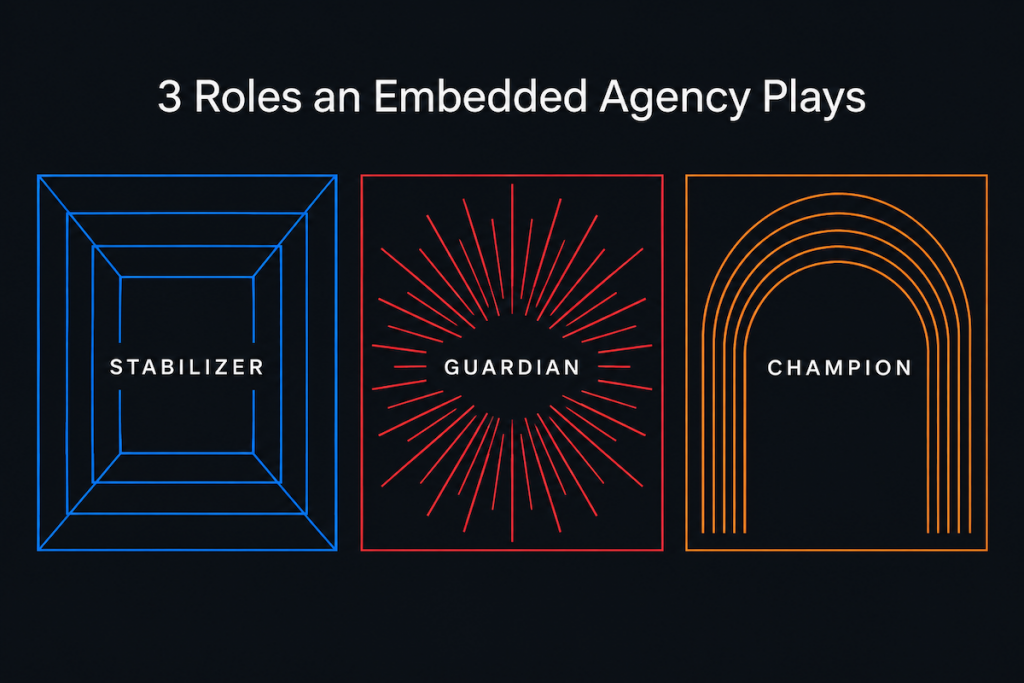
The alternative is an embedded marketing agency sized to the institution itself: not a vendor, not a bloated agency, not a replacement for institutional leadership, but a persistent team of specialists extending the institution’s own capabilities. It plays three roles: Stabilizer, Guardian, Champion.
Stabilizer: creates continuity. Instead of one person carrying the weight of search, analytics, and content strategy, the institution gains a coordinated team working across institutional priorities: reputation, recruitment, community engagement and fundraising. These aren’t separate campaigns — they’re different expressions of the institutional story. Treating them as a connected system means every investment makes the next one work harder.
Elliance played a similar stabilizing role during Thomas Kunkel’s presidency at St. Norbert College (2008–2017), helping translate a decade of ambitious growth into a coherent public identity. As Kunkel led the $90M+ Campaign and oversaw more than $100 million in capital investment, Elliance sharpened St. Norbert’s position as the world’s only Norbertine institution of higher education rather than letting it become a generic regional liberal-arts story. Grounded in values like communio and radical hospitality, that consistency gave admissions and advancement a differentiated story to tell as the college set records for enrollment, diversity and endowment growth — a reminder that a stabilized brand and a growing balance sheet can be mutually reinforcing wins.
Guardian: protects and compounds institutional assets. For years, colleges have traded long-term assets for short-term growth — the traditional Online Program Manager model being one prominent example. Institutions have sometimes traded a significant share of tuition revenue for speed and outside control over marketing, data and technology. The real problem isn’t the percentage; it’s dependency. Who owns the audience, data, content, search authority and brand?
A Right-Sized Embedded Marketing Agency works inside institutional priorities while protecting and compounding institutional equity: enforcing brand standards, auditing vendors, building first-party data and creating reusable assets instead of disposable campaigns.
Elliance also served as a strategic operating partner during Al Miciak’s transition to the presidency at John Carroll University, helping protect strategic continuity by aligning marketing, enrollment and advancement as the university developed new strategic priorities, including the launch of its College of Health that would change the institution’s trajectory for decades to come.
Champion: extends institutional ambition. The embedded agency doesn’t merely stabilize what exists. It gives the institution the execution capacity to pursue opportunities it might otherwise lack the expertise or bandwidth to pursue.
AI-driven search is one such opportunity. As enrollment marketing expands beyond Google to answer engines such as ChatGPT, Gemini and Perplexity, smaller institutions can punch above their weight by making their expertise, programs and institutional story more visible and understandable to AI systems.
Our work with the University of Cincinnati Donald P. Klekamp College of Law shows how the Right-Sized Agency keeps strategic authority and institutional knowledge close to leadership. We worked closely with Dean Haider Hamoudi as he evolved his strategic plan, giving it the digital horsepower to engage far-flung alumni and partners and support his pitch for a destiny-changing naming gift. That kind of performance requires digital experience and capabilities that many small and midsized institutions and professional schools cannot reasonably maintain entirely in-house.
The same principle applies to paid media. Paid media should be balanced by investment in assets — authoritative content, search visibility, reputation — that make tomorrow’s audience cheaper to reach.
Not Just an Outsourcing Decision
A Right-Sized Embedded Marketing Agency creates two kinds of leverage:
More Innovative Capability Without Organizational Bloat
An internal marketing team lives inside a single institution. An embedded agency sees patterns across many. That outside perspective brings new ideas, technologies and lessons into the institution without requiring it to hire every specialist or build every capability itself.
That perspective matters because higher education is changing quickly. Professional schools, for example, face a version of the same pressure. When application volume is strong, competition shifts to applicant quality, yield and reputation rather than simply generating more applications. Weak differentiation still extracts a price.
But the tax can run in reverse: distinctive positioning can drive organic visibility, stronger consideration, better yield and greater capacity to reinvest — creating a flywheel worth building.
Being hard to find is expensive. Being indistinguishable is more expensive still. Institutions can reverse that tax by creating a powerful compounding system in which reputation, content, technology and enrollment performance work together rather than as separate functions.
More Specialized Capability Without the Cost of Building It In-House
You can’t economically build every capability you need, and you shouldn’t have to.
The cost of an internal marketing operation isn’t limited to salaries. There are benefits, recruiting, management, technology, training, professional development and the ongoing challenge of maintaining specialized expertise that may only be needed part of the time.
An embedded model gives an institution access to specialized capabilities without requiring it to build every one of them internally.
The goal isn’t to minimize headcount. It’s to maximize capability.
Thinking about what the right mix of internal and external marketing capability looks like for your institution? Let’s talk.