
| Jan 26, 2024
Higher Education Website Audit Agency for Colleges and Universities
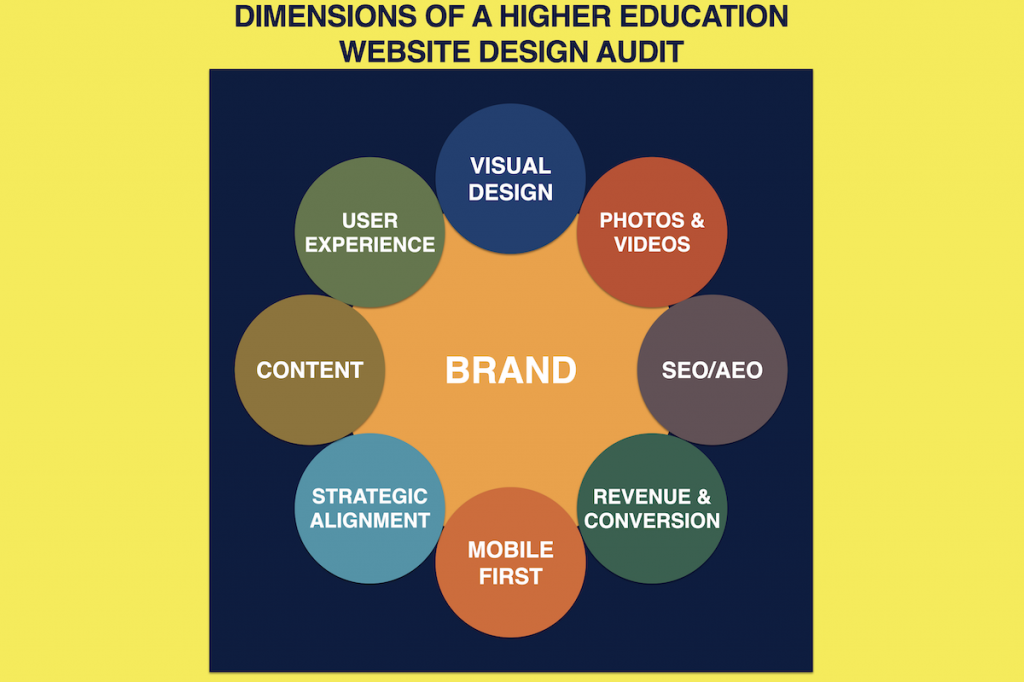
Today, more than any other marketing touch point, a website is the digital soul of an institution. All roads lead to it. It is where prospective students and families evaluate programs, researchers and partners explore collaboration, alumni reconnect, donors learn about impact and many audiences take the next step. As a leading website design agency for colleges and universities, higher education institutions frequently come to us for comprehensive website audits that reveal what’s working, what’s not and what should be improved. These are the ten dimensions of our website audit:
1. Brand Audit
First and foremost, we ensure that the college’s brand essence and brand values are infused into the entire website experience. We evaluate consistent application of brand identity, color and typography.
2. User Experience Audit
User experience is important to both human beings and search/AI engines.
Great websites are not only responsive and accessible, they are also intuitive, easy to use, readable and engender trust. Their persistent navigation and prominent calls-to-action systems put the users in control. Their Sitemap (org structure) and Wireframes (page schematics) – not just design and copy – create a logical content hierarchy and make a compelling argument. Balancing logic and emotion, stories and facts, they progressively disclose the information to create brand preference. All this is done with the understanding that prospective students are on their personal hero’s journey to realize their life ambitions, and donors on their journey to life of meaningful fulfillment.
The winning user experiences are the result of close collaboration among strategists, information architects, designers, writers, SEO/GEO/AIO marketers, and front-end and back-end developers. The result is a better experience not only for key audiences, but also for search engines, and AI-powered discovery systems that rely on clear information and page architecture to understand a website.
We evaluate websites to ensure they live up to these criteria.
3. Content Audit
For each audience and persona, we evaluate whether the website’s content is clear, persuasive, useful and distinctive. We assess how effectively it constructs an argument, answers audience questions, builds trust, demonstrates institutional value, and moves users toward action.
We look specifically at whether the university elevates its academic strengths, tells compelling student and alumni stories, demonstrates thought leadership, and provides the information audiences need to make decisions.
- Academic Program Page Audit – First, we audit academic program copy, because these are money pages where prospective students and families make their decisions. Many university websites are losing the AI battle because the answers to commonly asked questions about an academic program are scattered across dozens of pages, buried in institution-first language. What actually works is a single, high-fidelity academic program page that addresses their core questions in one place: Can I afford this? Will I get in? Who’ll teach me? What opportunities will I have? What’s campus life like? Will this degree get me a job? Will I be happy here? Give them clear answers in one place, and you make the page more useful for the student and search and AI systems. We also evaluate whether it is infused with appropriate keywords and keyword derivatives.
- Blog Audit – We analyze blog architecture, topics and individual posts to determine whether the institution sufficiently covers educational-intent searches and provides useful, authoritative content for prospective students, families and other audiences.
- Magazine Audit – We evaluate digital magazine architecture, including categories, tags and article topics, to determine whether the institution is adequately amplifying reputation, expertise, faculty accomplishments, research and thought leadership.
- News Audit – We evaluate news architecture and content to ensure announcements, events, people, achievements and institutional developments are current, discoverable and reflective of the university’s momentum and vitality.
- International Student Content Audit – We evaluate whether international audiences can find clear, culturally relevant and persuasive information about programs, admissions, costs, visas, student life and other critical decision factors. Where appropriate, we assess translated and country-specific content.
- Alumni Content Audit – We assess the depth and breadth of alumni storytelling, engagement content, outcomes, chapter coverage and opportunities for alumni to remain connected to the institution.
- Giving Content Audit – We evaluate whether the website makes a compelling case for philanthropy, clearly articulating institutional priorities, impact, giving opportunities and the difference donors can make at different levels of support.
- Partner Content Audit – For research, corporate and community partners, we assess whether the website clearly communicates areas of expertise, centers and institutes, partnership opportunities, proof of impact and pathways for engagement.
Finally, we score the website’s content against five fundamental qualities: clarity, brevity, simplicity, focus and posture—helping identify where content should be simplified, strengthened, consolidated, differentiated or repositioned.
4. Photography/Video Audit
Because the website is managed by distributed content owners with uneven appreciation of the power of photography as a story-telling and reputation-building tool, iconic photographs, if they exist, often are buried deeper in the site than they should be. The best photographs must be orchestrated in service of storytelling and support argument construction so they too help realize the website goals. After evaluating all this, we determine if additional photoshoots are desirable. Ditto for videos.
5. SEO/GEO/AIO Audit
We evaluate SEO, GEO and AIO across six dimensions:
- Technical Factors – We begin by testing site load speed, mobile/desktop performance, and HTTPS and security configuration. We ensure that all pages are indexed, robots.txt files are present and rational, XML sitemaps and 404 pages are present.
- On-Page Factors – We evaluate website domain names, sub-domains and URLs to ensure they are rational, descriptive and hierarchical. We validate that meta-data is filled with intelligent copy. We ensure page copy is not only focused and persuasive but is also infused with appropriate keywords. We evaluate the quality of HTML and CSS (Cascading Style Sheets) which are instructions to browsers to determine characteristics of web page elements such as text size, position of elements on the page, etc. We evaluate accessibility against WCAG 2.2 guidelines and applicable accessibility requirements. We size up internal linking. For blogs, we audit their categories, tags and content to reveal areas of improvement.
- Off-Page Factors – We review conversations taking place on other websites and evaluate quality and quantity of inbound links back to the website.
- Social Factors Audit – We ensure that social sharing buttons and Open Graph (OG) tags that facilitate content sharing are properly implemented so content is presented effectively when shared across platforms.
- Location Factors Audit – We ensure that location signals are embedded for the geographies you serve or wish to serve.
- GEO/AIO Factors Audit – We evaluate how well the website’s content and technical foundations can be understood, discovered, retrieved and represented by AI-powered search and answer engines. We look at structured data, entity clarity, topical authority, factual consistency, original research, quotations, statistics, content comprehensibility and other factors that can influence how an institution is discovered and represented in AI-generated answers.
6. Revenue and Conversion Architecture Audit
Since a website is a college’s number one inquiry and application generation tool, we evaluate if it’s efficiently constructed to maximize them. We ensure that users are not only able to inquire, apply and sign up for a visit, but are able to access thought-leadership content.
7. Visual Design Audit
People are inherently very visual. All the hard work of strategy and planning is wasted if the website isn’t beautiful, uncluttered and distinctive. We score the website design on a ‘Wow’ scale.
8. Mobile-First Audit
Prospective students increasingly experience a university website first on a smartphone. We evaluate the website’s mobile experience across responsive layouts, navigation, forms, performance, readability and key conversion paths.
9. Business Strategy Audit
No money, no mission. A website should protect a college’s signature programs, and liberate new prosperity by expanding into new markets/segments with new or existing programs. It ought to foster selling highest-value degrees to highest-value prospects. We look for all this during our audit.
10. Human Centricity Audit
Great brands always remember that prospects, students, alumni, donors and partners are real people, with real needs, wants, motivations and ambitions. They never forget that they are in the business of making the lives of their stakeholders easier and helping them realize their ambitions. We will evaluate a college brand’s language for factors like empathy and humanity.
Armed with the audit, higher education marketers can decide if they should simply streamline their current website or undertake a redesign.
If you are seeking a higher education website design agency to grow your enrollment, endowment and reputation, consider partnering with us.