
| Feb 3, 2026
How marketing agencies launch interdisciplinary and integrative academic programs in the age of AI
Colleges and universities understand the importance of new, future-fit programs for an audience of undergraduate prospects who are asking different questions about the changing nature of work and skill development.
Even as everything changes, one thing remains constant. If students can’t find your program, they can’t choose it. But “finding” no longer only means scrolling Google results or clicking ads alone.
Undergraduates are now also discovering programs through AI-assisted search, conversational tools, social feeds, and recommendation engines that summarize, interpret, and compare — often before a prospect ever lands on your website.
Many new academic programs are being designed at the intersection of departmental strength and employer demand, reflecting a broader shift toward interdisciplinary, computation-infused education. Forward-looking programs increasingly merge traditional fields — law, political science, engineering, business, accounting, journalism, and the humanities — with data science, AI, and emerging technologies to address complex, real-world challenges.
These programs prepare students not just to master a discipline, but to operate fluently across systems: lawyers trained to interrogate algorithms and digital evidence; political scientists using machine learning to analyze policy and social behavior; engineers educated alongside business strategy to translate technical innovation into market impact; journalists and accountants leveraging analytics to uncover financial and corporate narratives; and humanists combining critical inquiry with digital media, computation, and creative production.
Across health, biology, public policy, sustainability, and technology, the common thread is vocational agility — programs intentionally built to multiply skills, not stack them, so graduates can adapt as industries evolve and new hybrid roles emerge.
For anyone launching and marketing integrative programs, a fundamentally different playbook is required.
1. Undergraduates Aren’t Just Searching for Programs. They’re Asking Questions.
Traditional SEO assumes students search for program names. AI search tools flip that assumption.
Prospects now ask questions like:
- “What careers combine engineering and entrepreneurship?”
- “Is there a degree that blends product development and business strategy?”
- “How do engineers become startup founders or innovation leaders?”
Implication:
In addition to securing Google rankings, your content strategy must be structured around questions, comparisons, and explanations, not just keywords and program titles.
This means:
- creating explainer content AI tools can summarize accurately,
- clearly articulating outcomes, use cases, and distinctions,
- and designing pages that answer “why this program exists” before “how to apply.”
If AI can’t understand your program, it can’t recommend it.
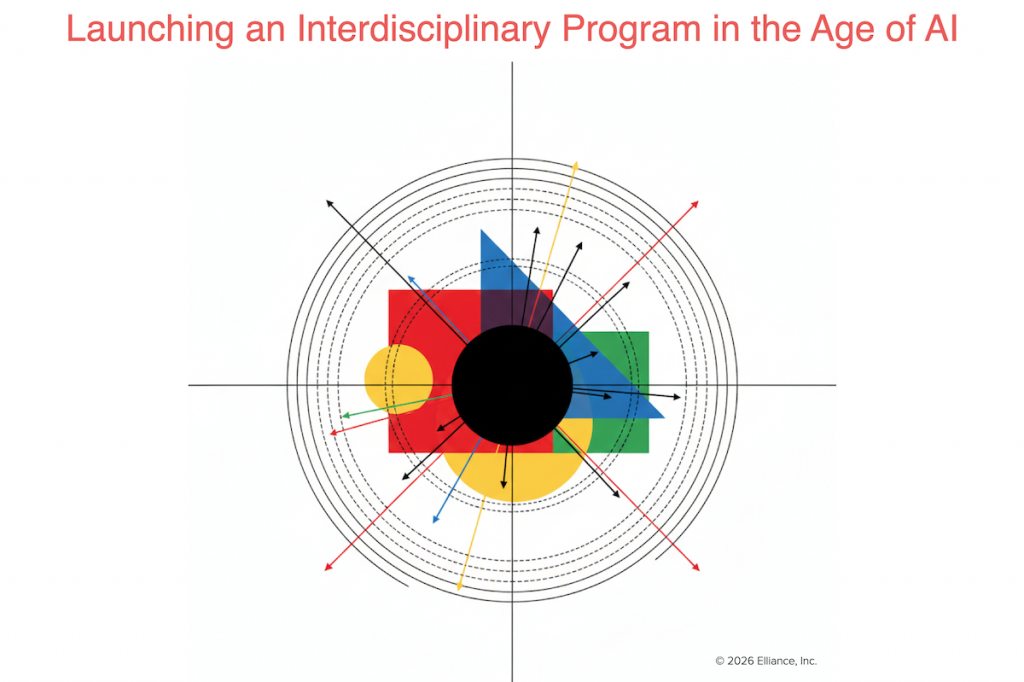
2. Marketing an Integrative Program Is Not About A or B — or Even A + B
Engineering + business is not a double major in disguise.
It’s not “half technical, half managerial.”
Strong integrative programs operate on a different logic:
Not A or B.
Not even A + B.
But A × B.
The marketing challenge is to make that multiplication visible.
That means:
- showing how technical decisions shape business outcomes,
- demonstrating how market forces influence engineering design,
- and telling stories where integration is the hero, not the disciplines themselves.
Implication: Campaigns should avoid siloed messaging (“for engineers” vs. “for business-minded students”) and instead spotlight:
- product development pathways
- innovation studios
- employer-defined problem spaces and
- real hybrid roles graduates are preparing for.
If your content can be separated cleanly into two disciplinary buckets, you’re under-selling the program.
3. Start with Industry When You Don’t Yet Have Program Recognition
New programs often face a credibility gap:
- strong employer participation,
- limited awareness among students and families.
In that scenario, the shortest path to student trust runs through industry.
Implication: Instead of leading with:
“Here’s our new program — please notice us,”
work backwards:
- Who are the employers already involved?
- What problems are they trying to solve?
- What skills gaps are they publicly talking about?
Then build promotion outward from those voices.
Industry validation does three things at once:
- It signals relevance.
- It clarifies outcomes.
- It creates third-party credibility no institution can manufacture on its own.
4. Treat Employers and Professionals as Influencers — Because They Are
For integrative undergraduate programs, employers aren’t just recruiters. They are content collaborators and attention multipliers.
Professionals already have:
- LinkedIn followings,
- credibility with STEM-oriented students,
- influence over counselors, parents, and educators.
Implication: Activate employers and professionals by:
- co-authoring blog posts or interviews
- creating short explainer videos what hybrid talent looks like in practice and encouraging sharing
- spotlighting advisory-boards and
- featuring “a day in the life” tied to real roles.
When industry professionals talk about the kind of graduate they wish existed, your program becomes the answer—without sounding like marketing.
5. Design Content for Discovery, Not Just Conversion
Early-stage prospects don’t want inquiry forms. They want clarity.
Implication: For integrative programs, your most important assets are:
- story-driven landing pages
- explainer articles that unpack “what this degree really is”
- visual frameworks that show how engineering and business intersect and
- examples of projects, not just courses.
Conversion comes later.
Discovery and understanding come first — especially in AI-mediated environments where summarized content shapes first impressions.
6. Build a Promotion Ecosystem, Not a Campaign
Launching an integrative program is less like flipping a switch and more like seeding a network.
Implication: Successful promotion aligns:
- AI-readable content
- employer-validated narratives
- faculty and industry voices and
- student-facing storytelling across channels.
The goal isn’t volume. It’s coherence.
When students encounter your program — from an AI answer, a LinkedIn post, a counselor conversation, or an employer quote — they should hear the same underlying story:
This is a program built for how real problems actually work.
The quiet truth about AI inclusions is that winning Google rankings is foundational for securing AI inclusions. I wrote about this symbiotic relationship in an earlier blog post titled Higher Education Generative Engine Optimization (GEO) for Colleges and Universities.
If you are seeking a smart higher education marketing agency which can help you join the elite group of successful programs we’ve launched, contact us.