
| Oct 10, 2026
Nursing School Website Design Agency: A Launchpad for Enrollment Growth
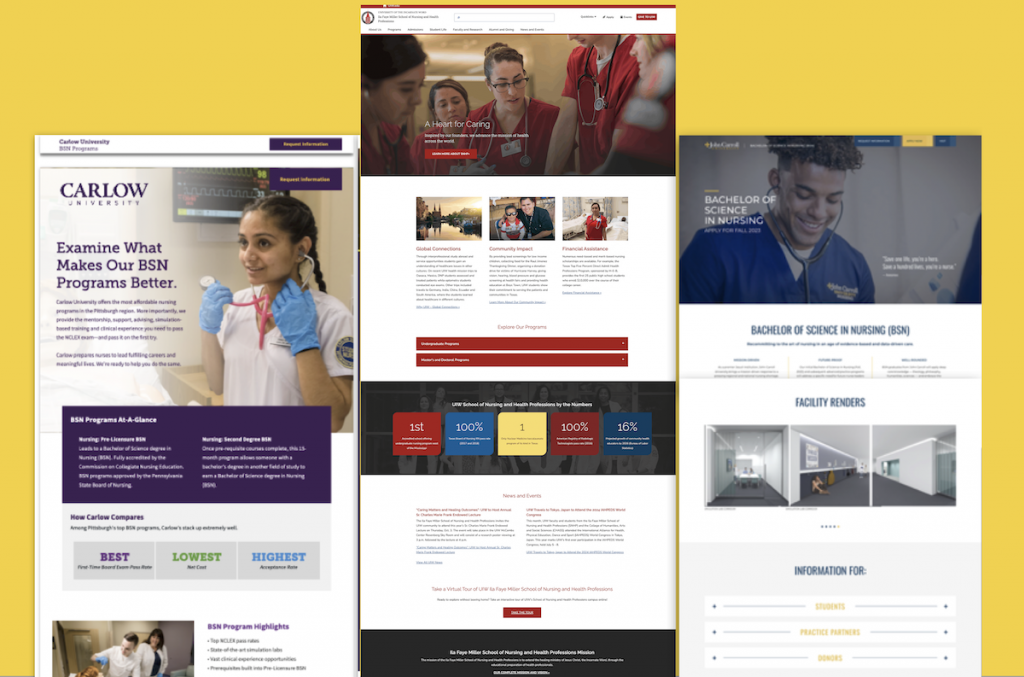
Great nursing school websites reflect the values of the profession: compassionate care, accessibility, ethical transparency and evidence-based practice. These values should shape everything from information architecture and content to visual design and development.
But a nursing school website must do more than look good. It must help prospective students evaluate programs, understand their options, build confidence and move toward enrollment.
It must also be discoverable. Before prospective students can evaluate a program, they need to find accurate, useful information about it through Google and AI-powered search and answer engines.
1. Person-Centered Design: Make Every Journey Intuitive
Just as nursing prioritizes individualized care, a nursing school website should accommodate the needs of distinct audiences. Give prospective undergraduate and graduate students clear pathways to explore programs, admission requirements and career outcomes, while ensuring current students, faculty and clinical partners can quickly find what they need.
Prospective students may feel overwhelmed by prerequisites, tuition and application requirements. Make their decisions easier by putting answers to critical questions—including accreditation, NCLEX pass rates and clinical placement opportunities—within easy reach.
2. Accessibility and Inclusion: Design for Everyone
Just as nursing embodies inclusion and nondiscrimination, a nursing school website should lead by example in digital accessibility. Design for keyboard navigation, screen readers, sufficient color contrast and descriptive alternative text. Aim for WCAG 2.2 AA, while ensuring compliance with the standards applicable to the institution.
Use plain language, readable typography, scannable content and ample white space to make information easier for everyone to understand.
3. Transparency and Integrity: Put the Facts Up Front
Just as ethical nursing practice demands honesty and accuracy, a nursing school website should clearly present key information: first-time NCLEX-RN and NCLEX-PN pass rates, CCNE or ACEN accreditation status, graduation and job placement rates, program costs, clinical requirements and rotation hours, and background check requirements.
4. Search and AI Visibility: Make Your Nursing Programs Discoverable
Even an exceptional nursing school website can’t grow enrollment if prospective students can’t find it. Today’s students may discover programs through Google and Bing, Google AI Overviews, ChatGPT, Gemini and Perplexity. Nursing schools need to compete for visibility across both traditional search results and AI-generated answers.
Start with dedicated, informative pages for each nursing program, degree pathway and campus. Answer the questions prospective students actually ask about prerequisites, accreditation, tuition, clinical placements, NCLEX pass rates and career opportunities. Build a strong technical SEO foundation, use structured data where appropriate and publish credible, up-to-date information that search engines and AI systems can interpret.
The goal is to make your nursing programs visible, credible and easy to evaluate wherever prospective students search for answers.
5. Authenticity: Show the Real Nursing Experience
Just as nursing relies on evidence, a nursing school website should show prospective students what the educational experience is really like. Feature authentic photography of students and faculty, along with videos and virtual tours of simulation suites, skills labs and community health partnerships.
Help prospective students picture themselves learning, practicing and preparing for a nursing career.
6. Clear Action Pathways: Turn Interest into Action
A nursing school website should make the next step obvious. Alongside a prominent “Apply Now” button, offer calls to action such as “Attend an Info Session,” “Download a Program Guide” and “Schedule a Lab Tour.”
Where practical, interactive tools such as transfer-credit guidance, tuition estimators and application deadline reminders can help prospective students resolve questions and move forward with confidence.
Putting Strategy into Practice
Effective nursing school websites combine audience research, thoughtful design, distinctive program content, SEO and AI visibility with conversion optimization to turn discovery into enrollment opportunities.
Elliance brings these disciplines together to help nursing schools stand out in competitive markets, attract qualified prospective students and turn interest into action. Here are four examples of how this approach works in practice.
The University of the Incarnate Word
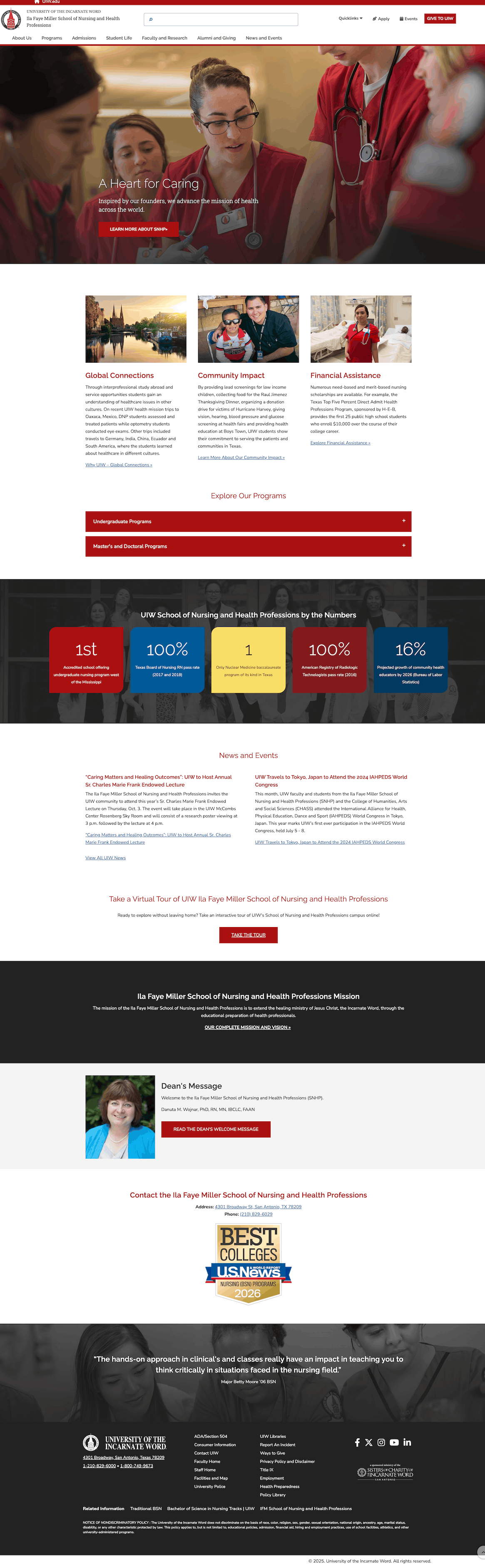
Elliance redesigned the nursing school website as part of a broader redesign spanning UIW’s health schools. The Ila Faye Miller School of Nursing and Health Professions offers flexible pathways, including an accelerated BSN and graduate DNP programs, serving students pursuing different stages of their nursing careers.
While total undergraduate enrollment across higher education faced headwinds, UIW’s nursing school has maintained strong demand by leaning into flexible degree pathways (ABSN and graduate DNP tracks) and maintaining high clinical placement capacity in San Antonio.
Carlow University: Outsmarting the Competition Through Content and SEO/AEO
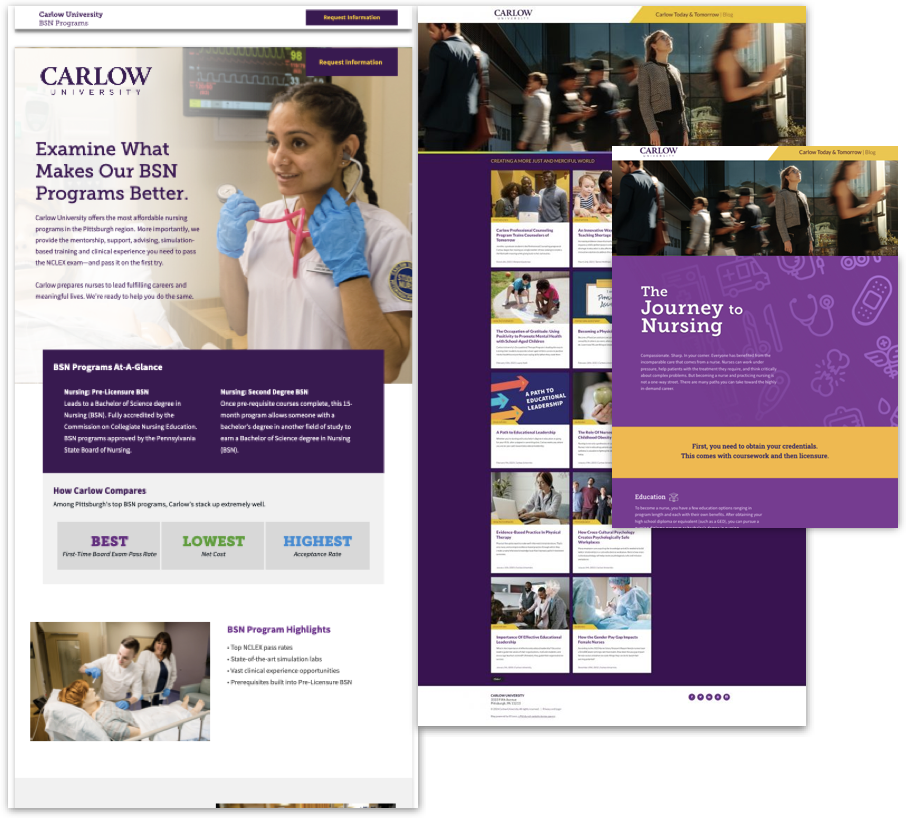
With NCLEX pass rates higher than all regional competitors, Carlow University had a compelling story to tell prospective nursing students and regional healthcare employers. The university turned to Elliance to grow applications and improve search visibility.
Elliance created a persuasive nursing landing page and wrote 16 nursing blog posts that were widely shared by prospective students and their families.
The posts earned more than 30 first-page Google rankings and were surfaced in AI-generated answers. Applications grew by 18%.
John Carroll University Launches a New Nursing Program
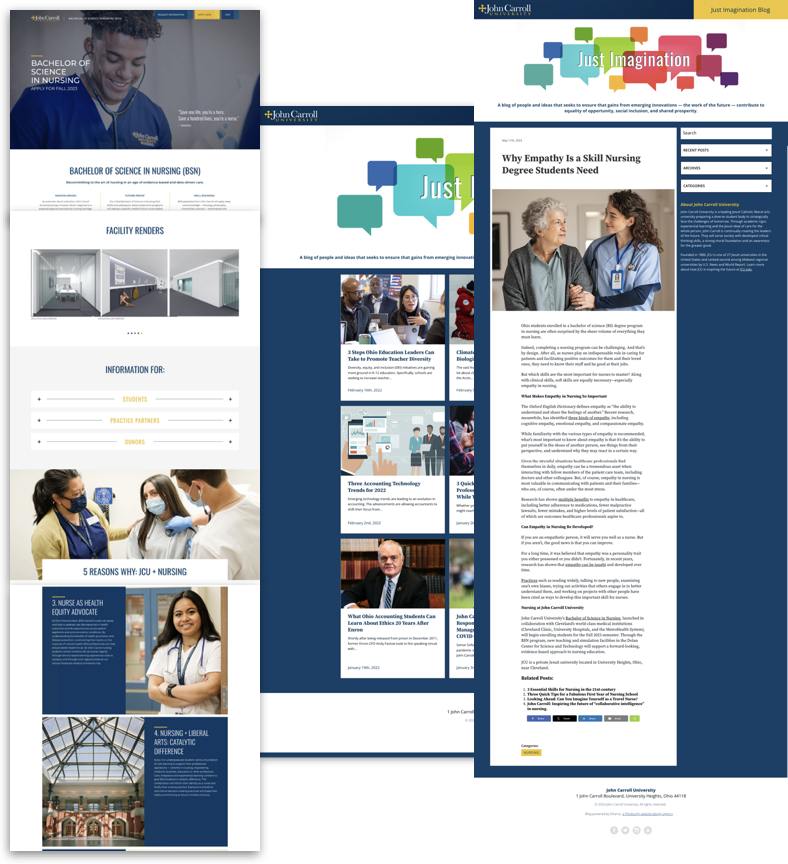
For generations, John Carroll University graduates have pursued nursing careers throughout the Cleveland region, including at respected institutions such as Cleveland Clinic. When the university set out to launch a new BSN program, its president turned to Elliance to help build the case.
Elliance researched JCU alumni on LinkedIn and interviewed graduates who had built nursing careers at leading healthcare institutions. Their experiences and insights helped establish the rationale for the new program.
Elliance created a persuasive nursing landing page and wrote 15 nursing blog posts that helped successfully launch the new BSN program.
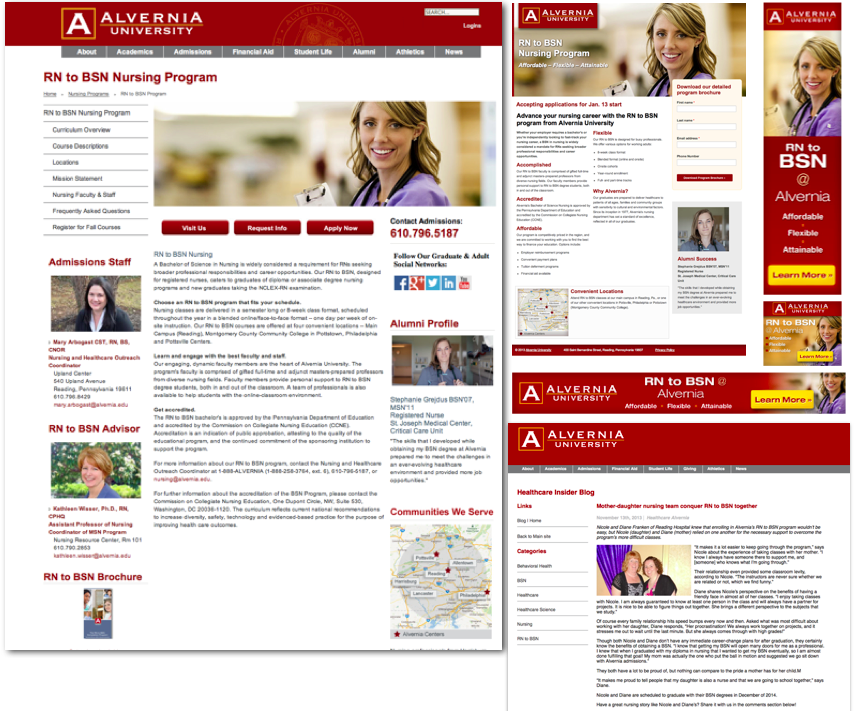
Alvernia University Grows RN-to-BSN Program
Alvernia University turned to Elliance to grow its RN-to-BSN program. Elliance began the process by interviewing its seasoned faculty, program chair, students and alumni.
Based on these findings, Elliance strengthened the RN-to-BSN program page. SEO improvements earned the program top-three Google rankings for more than 10 keywords in local and regional searches. Program-page traffic grew by 54%, clicks on “Request Information” increased by 50%, “Visit Us” clicks rose by 432% and “Apply Now” clicks grew by 71%.
Next, Elliance created a persuasive landing page and creative ads. After extensive A/B testing of ads and landing page copy, the page achieved an 8.1% lead conversion rate, three times the industry benchmark.
Our research uncovered a heartwarming mother-daughter nursing story that became the centerpiece of our social media campaign. Seventy-two people shared the story on LinkedIn. On Twitter, it was retweeted by J&J Nursing Notes, with 3,860 followers, and the CEO of NFP, with 1,700 followers.
Alvernia and Elliance later co-presented the results at a higher education conference.
Ready to Grow Nursing Enrollment?
Whether you’re launching a new nursing program or growing an established one, your website should do more than look good. It should differentiate your programs, make them discoverable in Google and AI-powered search, earn prospective students’ trust and turn interest into action.
Elliance combines nursing school website design, SEO, AI visibility, persuasive content and conversion optimization to help institutions compete more effectively and grow enrollment.