
| Aug 1, 2026
The Slow SEO/AIO Manifesto: The Slow Pursuit of Quality, Authority and Sustainable Traffic
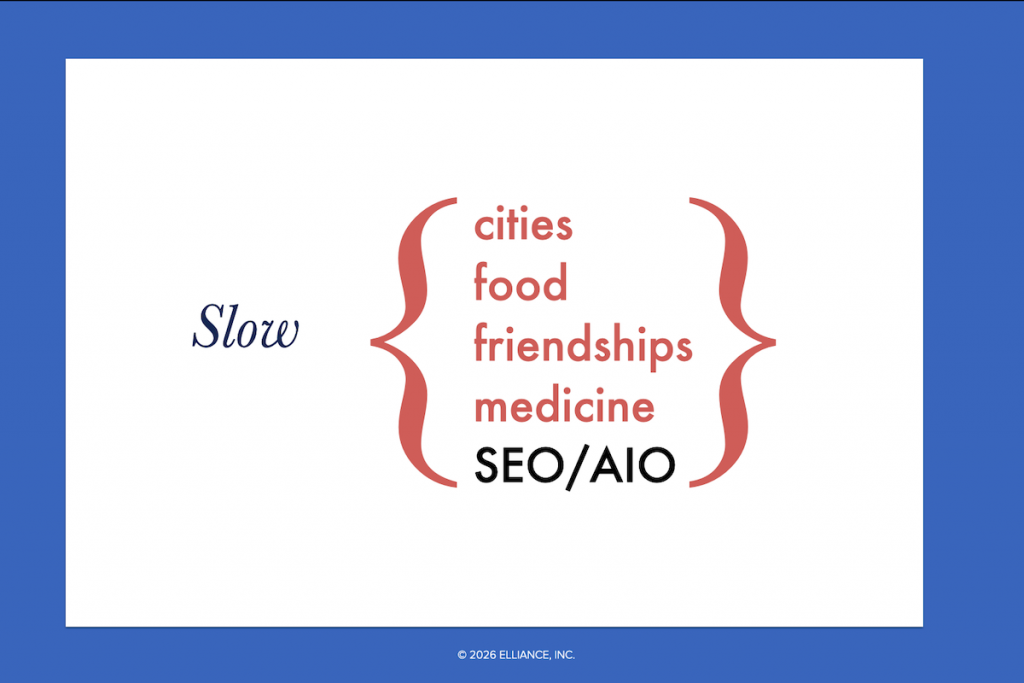
Everything appears to be speeding up with industrialization, automation, globalization, digitization and more recently with AI. To many, however speed kills and has created a counterculture of slowness. Back in 1986, the first McDonalds was opened. Immediately after, Carlo Petrini launched slow food movement as a protest against its ethos. He advocated for traditional regional cooking, with food ingredients grown in local farms, and savoring meals with family and friends. In 1999, the slow cities movement was born in Italy advocating for human-scaled urban planning, environmental sustainability, and preservation of local culture. In 2004, Carl Honoré published the classic “In Praise of Slowness: Challenging the Cult of Speed” in which he declared that faster is not always better and quality beats quantity. In 2011, Italian Cardiologist, Alberto Donzelli, formally launched the slow medicine movement pushing back against over-testing, over-medication and over-visiting doctors. The following year, Victoria Sweet published the classic “God’s Hotel” which advocated physicians to observe, listen and let the body heal naturally rather than treating patients like products on an assembly line. Nineteen years after social media burnout set in, the slow friendships movement took hold championing cultivation of trust over time.
In the midst of holding these tensions, there was one other quiet movement brewing that is noteworthy. Back in 1999, prevailing search engines shamelessly pandered to websites by surrendering to ranking gamesmanship powered by keyword stuffing and lofty claims of self-proclaimed greatness. As a counter-force, Google was born with the revolutionary idea of slow trust building: you are a great talent, company or organization and deserve to be ranked higher on search engines only if other websites cite you, and trust your greatness (i.e. citation index or GoogleRank). This movement advocated for achieving rankings with slow, deliberate pursuit of quality content, reputational authority and sustained rankings growth. For marketers in a hurry wishing to bypass this slow process, Google offered paid advertising, which to this day is less trusted than organic rankings.
In the age of AI, with advent of LLM engines like ChatGPT, Gemini and Perplexity, there is a new impetus to game the ranking system with boatloads, truckloads and trainloads of low-quality AI-generated content. However, people are smart. They have developed filters for AI-generated content and respect human-centered, subject-matter-expert-generated content. Google and LLM bots are rewarding fewer, in-depth, comprehensive, authoritative content that serves user intent over 20 thin, superficial articles. Smart SEO/AIO marketers are:
- serving people before algorithms: creating useful pages to solve real human problems.
- delivering quality over speed and quantity: writing 1-3 longer blog posts per month informed by subject matter experts with authoritative knowledge, unique tools and original data.
- updating and pruning more than creating: prioritizing auditing, pruning, upgrading, merging and modernizing existing site content/schemas over constantly creating new URLs.
- earning topical authority: with clear, logical content hierarchies (hub-and-spoke topic clusters) with deliberate internal linking using descriptive, contextual anchor texts.
- answering commonly asked questions with clarity: guiding readers towards clarity and meaning, not cleverness.
- naturally impacting metrics that matter: such as engagement signals (e.g. time on site), earning new, off-page links, growing domain authority, and most importantly business outcomes.
The future of SEO and AI optimization belongs not to those who publish the most content, but to those who earn the most trust. Slow is not the opposite of growth. Slow is how durable growth in SEO rankings and AI inclusions is built.
If you are too busy to defeat the SEO/AIO Goliaths in your space, review our high performance SEO services and higher education marketing capabilities, and consider partnering with us. We won’t disappoint.