
| Jan 4, 2026
How to Market Manufacturers and Industrial Companies
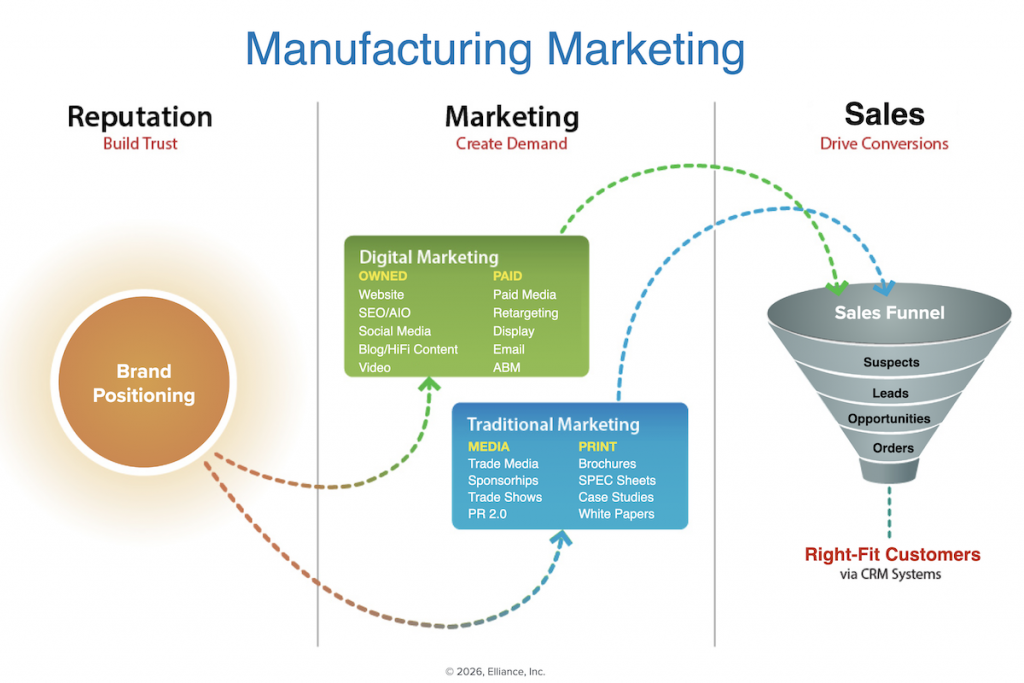
Manufacturing marketing is unique because it must persuade multiple technical and business stakeholders by proving real-world performance, reliability, and economic value rather than relying on brand awareness or emotional appeal.
In a typical manufacturing environment, purchase decisions are evaluated and approved by multiple stakeholders across technical, operational, financial, and executive functions. Engineers and technical evaluators care about performance and reliability, procurement focuses on cost risk and supply assurance, operations leaders prioritize uptime and ease of execution, and executives approving capital spend look for clear ROI strategic alignment and long term value. Therefore, we begin all our assignments by defining an ideal customer profile (ICP).
In addition, in manufacturing marketing, positioning matters far more than branding because buyers prioritize clear application fit, technical credibility, and risk reduction over slogans. For example, a supplier known for tight tolerances and fast turnaround in aerospace machining will win work even if competitors have stronger brand recognition.
With this foundational understanding, here’s our recommended framework for marketing an industrial company using a push and pull strategy:
1. Pull Strategy – Attract buyers to you
The pull approach positions your industrial company as the trusted solution provider that prospects actively seek.
Goal: Make your company discoverable and credible, so prospects seek you out as the solution.
Tactics:
- Website: An effective manufacturing company website must serve as a high-authority technical resource that prioritizes searchable product specifications and downloadable CAD files, establishes engineering credibility through certifications and case studies, and provides a clear, frictionless Request for Quote (RFQ) path for complex B2B buying committees.
- SEO/AIO Optimization: Ensure your website ranks for key technical terms, is optimized for user experience, and converts visitors with clear value messaging. Ensure that all product pages use schema.org’s structured meta-data using JSON-LD to mark up every product page with specific numerical_tolerance, material_composition and safety_rating tags. Vectorize your data to ensure that your technical manuals are converted into “vector embeddings” so RAG (retrieval-augmented-generation) systems like ChatGPT can accurately cite your tolerance specs.
- Paid Retargeting: Use retargeting ads to engage website visitors and nurture leads through the buying journey.
- Content Marketing: Publish case studies, technical white papers, and blogs demonstrating real-world problem-solving.
- Webinars & Workshops: Offer educational sessions to showcase expertise and applications.
- Thought Leadership: Build credibility on LinkedIn, industry publications, and online forums.
- Social Proof: Share customer testimonials, project success stories, and measurable outcomes.
2. Push Strategy – Directly reach target buyers
The push approach ensures your solutions are actively presented to decision-makers across technical and operational roles.
Goal: Directly influence purchasing decisions and accelerate the sales cycle with highly targeted engagement.
Tactics:
- Paid Advertising: Run targeted LinkedIn, Google Ads, and industry-specific display campaigns to reach decision-makers at key prospect accounts.
- Account-Based Marketing (ABM): Identify high-value industrial accounts and deliver personalized campaigns to engineers, procurement, operations, and executives.
- Sales Outreach: Equip your sales team with technical datasheets, product demos, and tailored collateral to reach key stakeholders.
- Trade Shows & Industry Events: Showcase capabilities through live demonstrations, prototypes, and networking.
- Distributor & Partner Promotions: Incentivize partners to highlight your solutions to their customer base.
3. Integration – Push + Pull with SEO/AIO and ABM
- Pull builds credibility and inbound demand: SEO/AIO-optimized content and thought leadership ensure that when those accounts research solutions, your company is top-of-mind.
- Push drives direct engagement: ABM and targeted sales efforts ensure high-value accounts know about your solutions.
- Combined impact: Faster sales cycles, stronger lead quality, and long-term industrial brand authority.
If you are seeking a manufacturing marketing agency partner with proven experience in aerospace and defense, automotive, chemicals, construction and engineering, electronics, energy, food and beverage, furniture, industrials, metals and mining, oil and gas, retail and consumer good, tooling, textile and apparel, transportation equipment, and wood and paper products companies, we would welcome a conversation.