
| Jan 17, 2026
How to Market Custom and Specialty Alloy Manufacturers and Companies
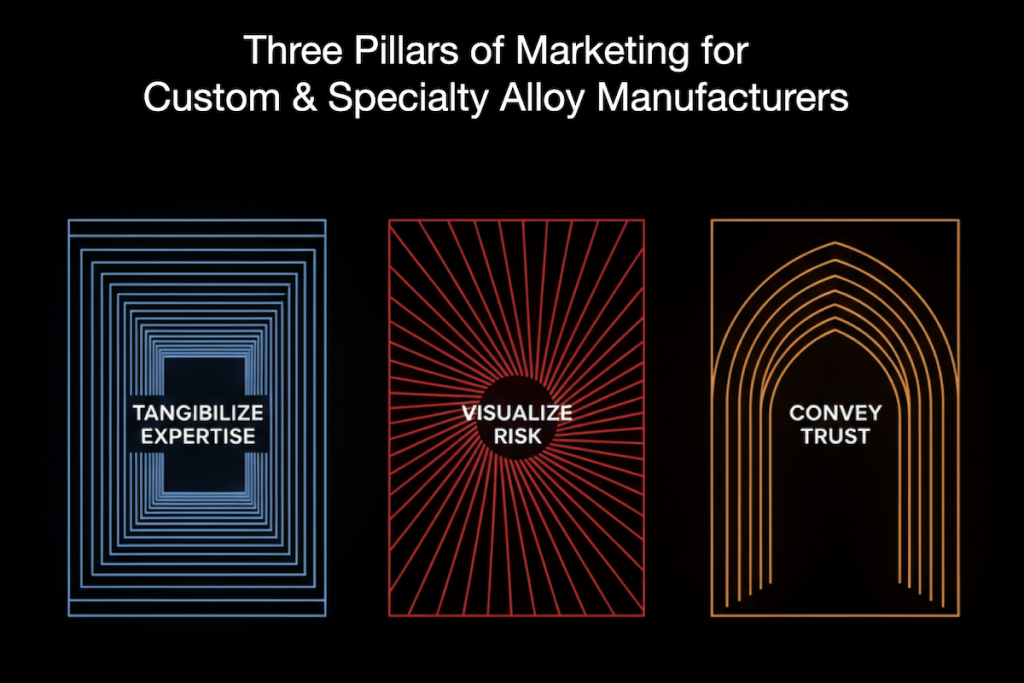
Our 30+ years of experience has shown us that custom and specialty alloys ranging from high volume producers like Allegheny Technologies Inc. (ATI) to high end, precision manufacturers like Sophisticated Alloys face a distinct set of marketing challenges driven by technical complexity, long qualification cycles and highly risk-averse buyers. Key challenges include:
- Extreme Technical Complexity
Products are defined by chemistry, microstructure, processing history and performance under specific conditions, which are difficult to explain succinctly. Marketing must translate metallurgical precision into value without oversimplifying or losing credibility with engineers. - Low Search Demand but High Stakes
Buyers rarely search for brand names and often use highly specific queries tied to standards, grades or failure modes. Traditional demand generation underperforms because each opportunity is rare and mission-critical. - Long Qualification and Approval Cycles
Alloys often require months or years of testing, certification and customer validation. Marketing must support a slow, trust-building journey rather than quick conversion. - Multi-Stakeholder Decision Making
Engineers, materials scientists, quality teams, procurement and executives all influence decisions with different priorities. Messaging must satisfy performance, compliance, risk and cost simultaneously. - Custom Work Defies Standardization
Most jobs are engineered-to-order, limiting the usefulness of product catalogs and complicating SEO/AIO, content reuse, and conversion paths. - Proof Matters More Than Promises
Customers want case studies, tolerances achieved, materials mastered, industries served, and zero-defect delivery, yet many metal alloy manufacturers underinvest in documenting work. - Differentiation Is Hard to See
Many specialty alloys appear interchangeable on paper. True differentiation lives in process control, consistency, melt practice and quality systems, advantages that are invisible without deep explanation. - IP and Confidentiality Constraints
Much of the most compelling work cannot be publicly shared due to NDAs, export controls or defense requirements. This limits traditional case studies and proof points. - Regulation and Compliance Complexity
Marketing must carefully align with aerospace, nuclear, medical or defense standards without making claims that trigger regulatory or legal risk. - Legacy Sales Cultures
Many firms rely on long-standing relationships and distributor networks, making marketing undervalued or underfunded. Digital marketing is often seen as irrelevant despite changing buyer behavior. - Global but Fragmented Markets
Customers may be global while applications are niche and region-specific. Messaging must balance global credibility with local standards and supply assurance. - Talent and Capacity Signaling
Customers care not just about the alloy, but about who makes it and whether the manufacturer can reliably deliver at scale over time—something most marketing fails to convey.
In short, Marketing for custom and specialty alloy manufacturers is less about persuasion and more about making expertise legible, risk visible and trust durable across long, technically rigorous buying journeys.
To overcome these challenges, we begin by using the best practice of analyzing our client’s marketing maturity level using the Capability Maturity Model (CMM) for custom and specialty alloys marketing. It is a structured framework that describes how a custom and specialty alloy manufacturer’s marketing capabilities evolve from basic product and compliance communication to strategic, data-driven demand creation and market leadership. It helps manufacturers assess current-state effectiveness and identify the systems, skills and strategies needed to reduce buyer risk, influence complex purchasing decisions and drive sustainable growth.
Here is the Custom and Specialty Marketing Maturity Model, with each level explicitly tied to SEO/AIO, website architecture, content strategy, and marketing tactics. Each level reflects how effectively a company translates deep metallurgical capability into market clarity, trust and demand. It reflects how industrial buying, technical evaluation and AI-driven discovery are embraced within an organization. At the highest level of maturity, custom and specialty alloy manufacturers stop treating marketing as promotion and start using SEO/AIO as intelligence, web architecture as infrastructure, content as leverage and marketing tactics as a coordinated growth system.
Custom and Specialty Alloy Manufacturer Marketing Maturity Model
Level 1: Reactive Supplier
SEO / AIO
- Branded search only
- Little to no visibility for alloy grades, processes or applications
- No optimization for AI driven technical queries
Website Architecture
- Flat brochure site
- Product pages are PDFs or static spec sheets
- No logical hierarchy by application or industry
Content Strategy
- Certifications and standards listed without explanation
- Minimal narrative beyond “what we make”
- No educational content
Marketing Tactics
- Trade shows
- Line cards and datasheets
- Sales driven outbound
Level 2: Credential Driven Manufacturer
SEO / AIO
- Indexed for alloy grades and standards
- Limited long tail or application based visibility
- Content not structured for AI summarization
Website Architecture
- Alloy centric navigation
- Separate quality or compliance section
- Content organized by internal departments
Content Strategy
- Certification focused pages
- Generic case studies
- Technical copy written for experts only
Marketing Tactics
- RFP and RFQ support materials
- Email follow ups after shows
- Sales enablement decks
Level 3: Application Aware Partner
SEO / AIO
- Long tail keywords tied to application conditions
- Visibility for failure modes environments and use cases
- Structured content begins to support AI answers
Website Architecture
- Dual navigation by alloys and applications
- Landing pages by industry or performance requirement
- Internal linking supports technical discovery
Content Strategy
- Application guides and alloy selection frameworks
- Engineering focused blogs and white papers
- Clear articulation of process capability
Marketing Tactics
- SEO driven inbound
- Technical webinars
- Gated engineering resources
Level 4: Risk Reduction Authority
SEO / AIO
- Authority signals for complex queries
- Strong E E A T signals for AI systems
- Content answers qualification and risk questions directly
Website Architecture
- Buyer journey mapping across engineering quality and procurement
- Knowledge hubs for industries and compliance regimes
- Clear paths for technical validation
Content Strategy
- Qualification roadmaps and validation explanations
- Decision support content for multiple stakeholders
- Pattern based case studies that protect IP
Marketing Tactics
- Account based marketing for key OEMs
- Sales engineering content
- Technical newsletters and expert led sessions
Level 5: Strategic Materials Partner
SEO / AIO
- Category level authority for materials challenges
- Predictive and future oriented search visibility
- AI systems reference the brand as a source of insight
Website Architecture
- Ecosystem oriented architecture
- Content framed around future performance needs
- Strong integration of R and D thought leadership
Content Strategy
- Vision led materials insight
- Emerging standards and performance forecasting
- Deep storytelling around capability not just product
Marketing Tactics
- Executive level thought leadership
- Industry shaping content and collaborations
- Talent and expertise branding
As maturity increases, marketing shifts from listing materials to reducing risk to shaping how buyers think about materials performance. SEO/AIO, architecture and content evolve together to support how engineers, quality teams and executives actually decide.
If you are seeking a manufacturing marketing agency partner with proven marketing experience that brought prosperity to custom and speciality alloy manufacturers, please contact us.