
| Jan 17, 2026
How to Market Metal Fabricators and Bring Prosperity to Them
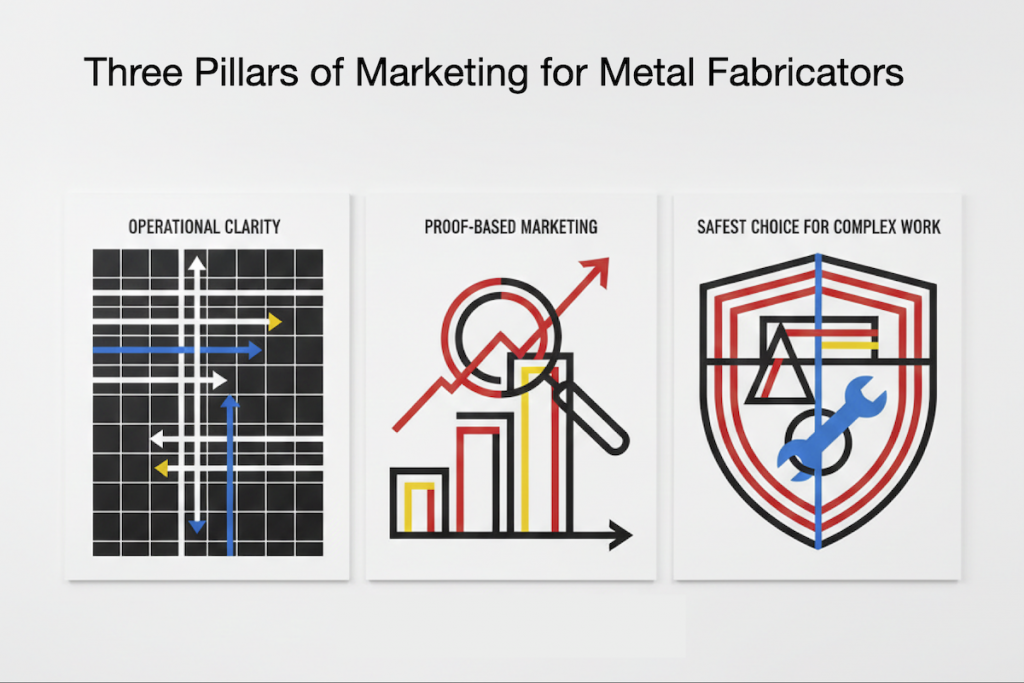
Our 30+ years of experience has shown us that metal fabricators ranging from heavy industrial, contract manufacturers like Miller Fabrication Systems to high end, precision manufacturers like Oberg Industries face a distinct set of marketing challenges driven by how buyers evaluate risk, capability, and long-term reliability rather than brand appeal alone. Key challenges include:
- Capability Is Hard to Explain Digitally
Fabrication strength lives in process control, tolerances, certifications, zero defect delivery and tribal knowledge, which are difficult to communicate clearly on a website without overwhelming non-engineers. - Buyers Are Engineers, Not Marketers
Decision-makers value specs, drawings, materials, and proof over slogans, making generic branding or lifestyle messaging ineffective. - Long, Multi-Stakeholder Sales Cycles
Purchases are vetted by engineering, procurement, operations, quality, and executives, each with different criteria, but few marketing teams address all simultaneously. - Differentiation Is Subtle
Many metal fabricators appear interchangeable (“ISO certified, on-time, high quality”), making positioning around niche capabilities, complexity, or risk reduction essential but often underdeveloped. - Custom Work Defies Standardization
Most jobs are engineered-to-order, limiting the usefulness of product catalogs and complicating SEO, content reuse, and conversion paths. - Proof Matters More Than Promises
Customers want case studies, tolerances achieved, materials mastered, industries served, and zero-defect delivery, yet many metal fabricators underinvest in documenting work. - Local Reputation vs. National and International Visibility
Metal fabricators often rely on word of mouth and repeat buyers, leaving them invisible to new OEMs or engineers searching online for qualified partners. - Price Pressure and RFQ-Driven Sales
Marketing must support sales in environments dominated by RFQs and price comparisons, where value, risk mitigation, and throughput must be clearly articulated. - Talent and Capacity Signaling
Customers want to know: can you scale? can you staff? can you hold quality under pressure? Yet few marketing efforts address workforce strength and operational maturity. - Underutilized Digital Foundations
Many fabricators have outdated websites, weak SEO/AIO for process or materials-based searches and little alignment between marketing and sales engineering.
In short, metal fabricator marketing succeeds when it shifts from promotion to proof, from brand claims to operational clarity, and from “what we make” to “why we’re the safest choice for complex work.”
To overcome these challenges, we begin by using the best practice of analyzing our client’s marketing maturity level using the Capability Maturity Model (CMM) for metal fabricators marketing. It is a structured framework that describes how a metal fabricator’s marketing capabilities evolve from basic product and compliance communication to strategic, data-driven demand creation and market leadership. It helps manufacturers assess current-state effectiveness and identify the systems, skills and strategies needed to reduce buyer risk, influence complex purchasing decisions and drive sustainable growth.
Here is the Metal Fabricators Marketing Maturity Model, with each level explicitly tied to SEO/AIO, website architecture, content strategy, and marketing tactics. It reflects how industrial buying, technical evaluation and AI-driven discovery are embraced within an organization. At the highest level of maturity, metal fabricators stop treating marketing as promotion and start using SEO/AIO as intelligence, web architecture as infrastructure, content as leverage and marketing tactics as a coordinated growth system.
Metal Fabricators Marketing Maturity Model
Level 1: Reactive / Relationship-Driven
SEO / AIO
- Little to no intentional SEO
- Branded searches only
- No optimization for process, material or tolerance queries
- Invisible to AI search and answer engines
Website Architecture
- Flat, brochure-style site
- Homepage + About + Capabilities + Contact
- Capabilities lumped together with minimal depth
Content Strategy
- Static copy describing “what we do”
- No problem framing or outcomes
- No differentiation between processes or buyers
Tactics
- Word of mouth
- Sales-driven outreach
- Trade show presence only
- PDF line cards shared offline
Level 2: Credibility-Focused
SEO / AIO
- Basic on-page SEO
- Indexed pages for services and industries
- Still mostly branded or navigational traffic
- Minimal AI-readable structure
Website Architecture
- Capabilities split into individual pages
- Certifications and quality highlighted
- Equipment lists emphasized over outcomes
Content Strategy
- Reassurance-focused content
- “We are certified, experienced, reliable”
- Early case examples but thin detail
Tactics
- Trade shows and industry directories
- Downloadable spec sheets
- Sales enablement PDFs
- Basic Google Business and directory listings
Level 3: Capability-Articulated
SEO / AIO
- Optimization around process, material and tolerance queries
- Structured headings and internal linking
- Schema for services and organization
- Early visibility in AI-generated summaries
Website Architecture
- Process-based navigation
- Individual pages for materials, tolerances, finishing and QA
- Clear paths for engineers vs procurement
Content Strategy
- Explains how work is done
- Process walkthroughs and technical explainers
- Content built around buyer questions and risk points
Tactics
- Technical blogs and FAQs
- Process diagrams and videos
- SEO-driven landing pages
- Sales team using content during qualification
Level 4: Positioned Specialist
SEO / AIO
- Strong non-branded visibility in complex searches
- Content optimized for “best for” and “how to choose” queries
- AI engines recognize topical authority
- Rich schema and entity clarity
Website Architecture
- Clear positioning by complexity or niche
- Industry or application pathways
- Case study hubs tied to capabilities and outcomes
Content Strategy
- Outcome-driven storytelling
- Demonstrates risk reduction, reliability and precision
- Speaks to engineers, procurement and operations distinctly
Tactics
- Case studies with metrics
- Buyer guides and comparison content
- Targeted ABM landing pages
- Sales and marketing fully aligned
Level 5: Strategic Manufacturing Partner
SEO / AIO
- Dominant authority in priority niches
- Recognized by AI engines as a trusted source
- Featured in summaries and recommendations
- Entity-level credibility established
Website Architecture
- Modular, scalable architecture
- Integration of talent, capacity and innovation stories
- Content ecosystems that support long sales cycles
Content Strategy
- Thought leadership on manufacturing strategy
- Capacity, workforce and scalability narratives
- Long-term partnership positioning
Tactics
- Executive-level content and insights
- Account-based marketing at enterprise scale
- Industry reports and original research
- Employer branding integrated with marketing
Once we understand the level of maturity of our client’s marketing, we develop a concrete plan of action to steer them to the next levels using the listed initiatives.
If you are seeking a manufacturing marketing agency partner with proven marketing experience that brought prosperity to metal fabricators, please contact us.