
| Aug 13, 2012
College Turnaround Strategies
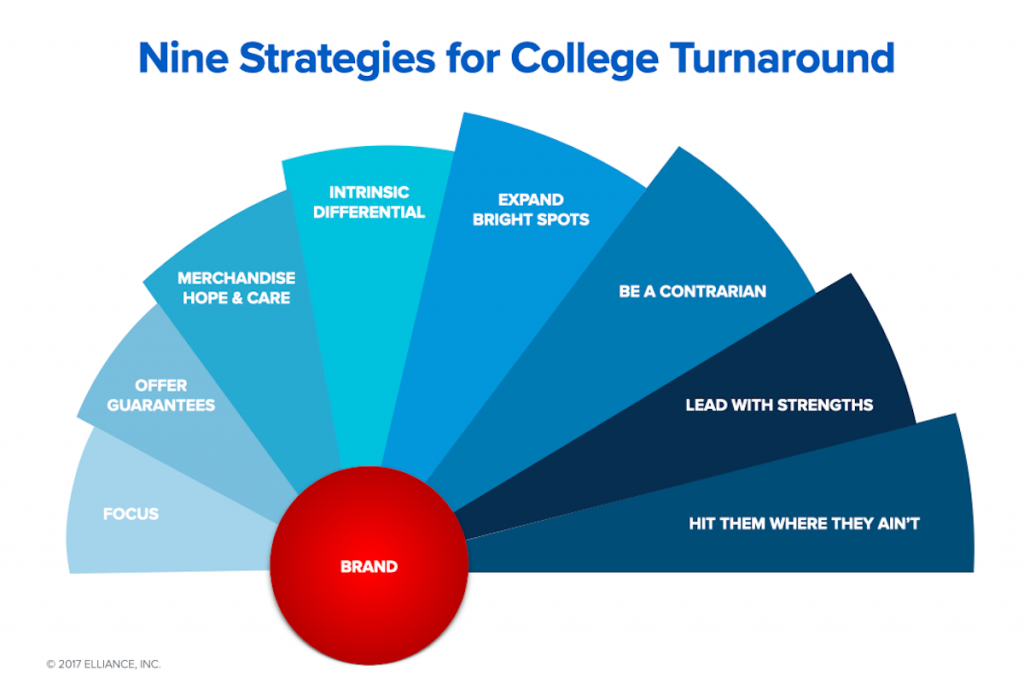
In an era of declining demographics and shifting applicant priorities, how does a college capture an outsized share of a shrinking market? It requires more than incremental changes. Visionary college presidents and administrative leaders deploy these 10 strategies to fortify positioning, differentiate their brand, and drive institutional turnarounds:
1. Invest in Branding. Babson has positioned itself as THE college for entrepreneurship, American University as THE hub for political “wonks,” Drexel built its identity around mandatory co-op experience. A sharp, singular brand identity can elevate an institution from regional obscurity to national prominence.
2. Focus. Resist the urge to be everything to everyone. Palo Alto University focuses exclusively on psychology and behavioral health, Gallaudet University is a leader in education for deaf & hard of hearing students, Florida Polytechnic serves as the sunshine state’s dedicated STEM institution, and Thunderbird School of Management specializes in international business. Inch-wide, mile deep.
3. Offer guarantees. Whether it is a graduate-in-four-years guarantee (e.g. Randolph-Macon College), a job guarantee (e.g. Capitol Technology University) or a tuition lock (e.g. William Woods University grad and online programs), parents and students are attracted to colleges willing to stand behind their commitments.
4. Merchandise hope and care. Charismatic President “Buck” Smith put the tiny Davis & Elkins College nestled in remote Appalachia on a path of prosperity based on sheer power of good old-fashioned values of hope, optimism, decency, encouragement, generosity of spirit and nurturing of relationships. The college, once bleeding, is now operating debt free.
5. Leverage intrinsic differential. Where others saw a school in distress, President Norman Smith of Wagner College saw prime real estate facing New York City. He used that as the enticement for attracting students from the entire Northeast. After all, who wouldn’t want to be near The City, and live in a pristine bucolic setting? Students showed up in droves.
6. Expand bright spots. President Arthur Kirk walks into Saint Leo University, sees the depth of experience the university has amassed in distance learning while serving members of the mobile active-duty military. He decides to deploy the same technology to serve adult students nationwide with online programs. Thus begins an amazing success story in which we played an integral role.
7. Be a contrarian. Zig when others are zagging. While most colleges are still using traditional student search strategies (i.e. buying names, sending them a ton of emails/postcards, whittling the names down to a small number of interested students, and courting them ferociously), smart colleges are embracing influencer marketing, micro-segmentation, 1-to-1 marketing, look-alikes, algorithmic recommendations and A/B testing that Google and social media platforms are now supporting with their big-data-based machine-learning algorithms. As an example, read the William Woods story.
8. Lead with strengths. Focus on the programs where the school has strengths and build from there. Or, as Dean Edward Snyder of Yale School of Management says in the New York Times: ‘Give up the undifferentiated, multi-brass-ring strategy of best recruiters, best students, best facilities, blah, blah, blah.’ Carnegie Mellon has expanded its portfolio of academic offerings by creating a vast empire of new degrees that leverage its reputation as an analytic and technology powerhouse.
9. Play where others aren’t playing. Think Elon University. No Harvard envy there. Elon attracts students who learn by doing and aren’t just academically strong. They practically own the “Engaged Learning” position in higher education.
10. Prove it. Many liberal arts institutions are buckling under pressure from a society that puts greater value on practical and vocational education. Not St. Edward’s, St. Olaf and Williams College. They have decided to embrace their strength in the liberal arts and are busy building a business case for why liberal arts education not only has an ROI, but is good for society and the world at large. Noteworthy among them is the valiant effort by Williams College which mapped the career paths of its 15,600 liberal arts alumni to illustrate that they go on to successful careers in all walks of life.
Deployed judiciously, these strategies will create an inflection point for any college seeking a turnaround. However, none of them will work well without a leader who leans in and a senior team that hustles and deeply cares for the well-being of its students.
Interested in turnaround? Learn more about our strategy and higher education marketing services, and contact us.